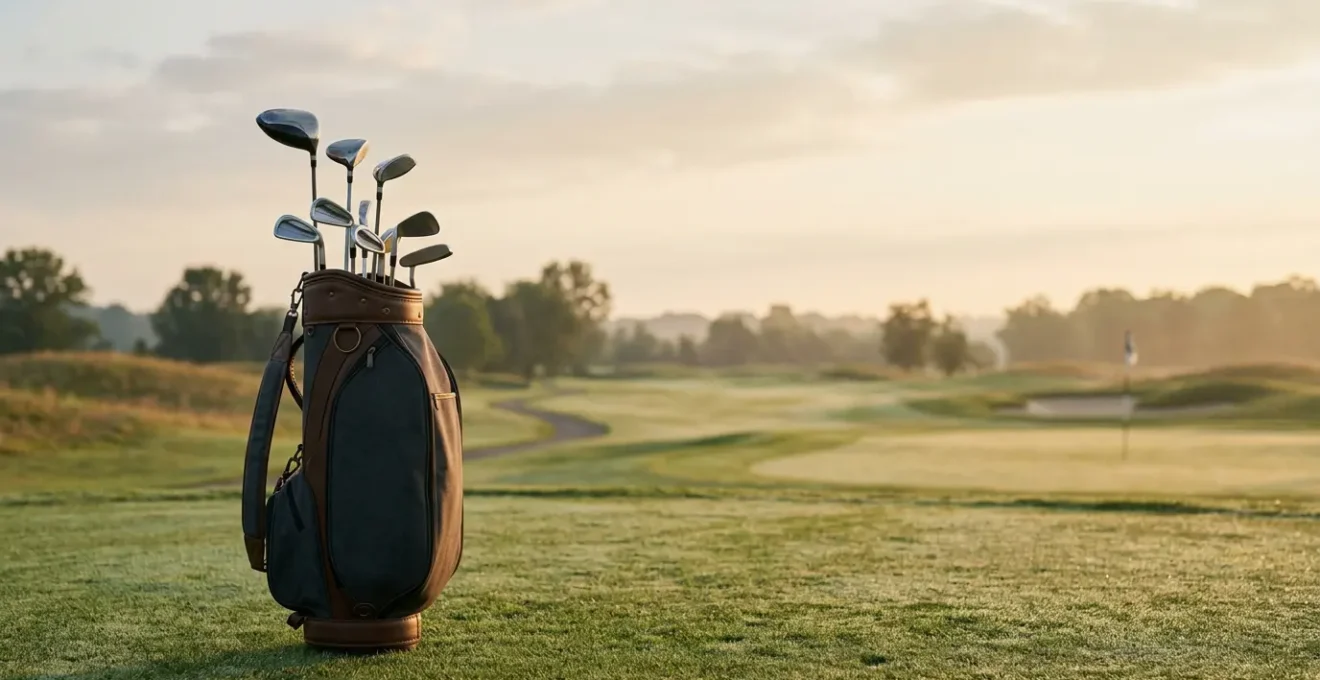
Building a high-performance golf bag on a budget isn’t about buying cheap clubs; it’s about making strategic investments in used, premium equipment and prioritizing skill development over gear.
- Focus on high-quality used irons that retain their value and provide superior feel.
- Allocate a significant portion of your budget to lessons, as technique yields more improvement than technology.
Recommendation: Follow a « Performance Blueprint » that dedicates roughly 50% of your budget to used clubs, 35% to lessons, and 15% to a professional fitting after your swing has stabilized.
The sticker shock of a new set of premium golf clubs can easily scare a new or returning player away from the game. Faced with prices soaring into the thousands, many golfers feel trapped between two bad options: buying a cheap, low-quality boxed set that hinders their development, or emptying their savings for equipment they don’t yet have the skill to appreciate. The common advice is often to « buy used, » but this vague suggestion fails to provide a real strategy and can lead to a bag full of mismatched, ill-fitting, or even counterfeit clubs.
The truth is, assembling a high-performance bag for under $1000 is entirely achievable. But the key isn’t simply being frugal; it’s about thinking like a savvy equipment investor, not a retail consumer. The secret lies in understanding the equipment market’s depreciation curve, prioritizing tools that accelerate learning, and strategically allocating your funds toward what truly lowers scores: skill development. This is not just a guide to buying clubs; it’s a blueprint for building a long-term performance advantage without breaking the bank.
This article will guide you through the critical decisions and knowledge necessary to build a smart, cost-effective golf bag. We will explore the principles of equipment value, proper fitting, and strategic investment to ensure every dollar you spend directly contributes to a better, more enjoyable game.
Contents: A Strategic Guide to Building Your Golf Bag
- Why Do Forged Irons Retain Value Better Than Cast Game-Improvement Clubs?
- How to Measure Wrist-to-Floor Distance for Correct Shaft Length?
- Blades or Cavity Backs: Which Iron Style Accelerates Learning?
- The Online Marketplace Mistake That Leaves You with Fake Wedges
- When to Change Your Grips to Prevent Club Slippage in Humid Weather?
- The Equipment Mistake That Alienates New Players from the Game
- Swing Lessons or Club Fitting: Which Improves Performance Faster?
- How to Use Golf to Develop Basic Athletic Skills in Children?
Why Do Forged Irons Retain Value Better Than Cast Game-Improvement Clubs?
The first secret of the savvy golf equipment buyer is understanding the concept of a depreciation curve. Not all clubs lose value at the same rate. The manufacturing process plays a huge role in both performance and long-term worth. Game-improvement irons are typically ‘cast’ by pouring molten metal into a mold. This process is fast, inexpensive, and excellent for creating complex, forgiving shapes. However, the metal’s structure is less dense, which can result in a harsher feel at impact.
In contrast, ‘forged’ irons are stamped from a single, soft piece of carbon steel. This process is more labor-intensive and expensive, but it creates a denser, more uniform grain structure. The result is the buttery-soft feel that better players cherish and superior feedback on off-center hits. Because of this premium feel and build quality, forged irons from top brands have a much flatter depreciation curve. While a new set of cast irons might lose 50% of its value in the first year, a quality used forged set holds its value remarkably well. For instance, the Titleist AP2 712 irons, once over $1,000, can now be found for under $200, representing a massive value for a club that still performs at a high level.
This is why buying a set of used, forged « player’s irons » from a few generations ago is often a much smarter investment than buying new, cast game-improvement clubs. You get premium feel and quality for a fraction of the original cost. Furthermore, brands known for quality construction hold their value exceptionally well; indeed, Ping irons hold their value more than virtually any other brand, making them a safe and savvy purchase on the used market. You’re not just buying a club; you’re buying an asset that will retain more of its worth when you’re ready to upgrade.
How to Measure Wrist-to-Floor Distance for Correct Shaft Length?
The most expensive clubs in the world won’t work if they don’t fit your body. Before you spend a single dollar, you must determine the correct club length for your build. The most critical factor in this equation is your wrist-to-floor (WTF) measurement. This simple data point dictates the proper shaft length needed to put you in a natural, athletic address position. Playing with clubs that are too long or too short forces compensations in your posture and swing, ingraining bad habits that are difficult to correct later.
Getting this measurement is a simple, five-minute task you can do at home before you even start browsing online marketplaces. It is the single most effective step you can take to avoid buying a set of clubs that is fundamentally wrong for you. The illustration below shows the correct posture and measurement point.
Once you have this number, you have a powerful filter for your search. You can immediately disregard any deals on clubs that don’t match your required length, saving you time and preventing a costly mistake. This simple process empowers you to shop with the confidence of a professional club fitter.
Your Action Plan: DIY Wrist-to-Floor Measurement
- Get into Position: Stand on a solid, flat floor wearing normal street or running shoes. Stand with your back flat against a wall, with your feet together and your head and shoulders touching the wall.
- Relax Your Arms: Let your arms hang straight down by your sides in a completely natural and relaxed position. Do not shrug your shoulders or tense your arms.
- Take the Measurement: Have a friend measure the distance from the floor to the major crease in your wrist (where your hand hinges forward).
- Interpret the Result: A measurement under 32 inches suggests you may need clubs that are 1 inch shorter than standard. A measurement between 32 and 35 inches typically fits standard length. A measurement above 35 inches suggests you may need clubs that are 0.5 to 1 inch longer than standard.
- Apply to Your Search: Use this information to filter online listings and ask sellers for length specifications before purchasing.
Blades or Cavity Backs: Which Iron Style Accelerates Learning?
The debate between « blades » (or muscle backs) and « cavity backs » is a classic one. The common wisdom is clear and correct: beginners should start with cavity back, game-improvement irons. These clubs feature perimeter weighting, which makes them significantly more forgiving on off-center hits. Considering that research on ball-striking patterns shows most golfers miss the center of the clubface on 60-70% of their shots, this forgiveness is not a luxury—it’s a necessity for maintaining distance, accuracy, and enjoyment while learning. A controlled test with beginner golfers confirmed this, showing that every participant hit a Titleist cavity-backed iron consistently farther than its blade counterpart.
However, the savvy player understands a deeper concept: accelerated learning. While blades are punishing, they offer brutally honest and immediate feedback. A perfectly struck blade feels effortless, while a miss provides a distinct vibration and a significant loss of distance. This creates what learning theorists call « desirable difficulty. » The precise, unfiltered feedback forces a player to develop superior ball-striking skills, balance, and swing sequencing more quickly. A cavity back, by design, masks some of the sensory information from a minor mishit, making it harder to diagnose swing flaws.
So, what’s the verdict for the budget-conscious beginner? Start with forgiving cavity backs. They will make the game more fun and help you build a foundational, repeatable swing without the frustration of constant mishits. But as you improve, don’t be afraid to eventually transition to a set of used forged blades or « player’s cavity backs. » The enhanced feedback will challenge you to refine your swing and can ultimately make you a much better ball-striker in the long run. The goal is to match the club to your current skill, not just your aspiration.
The Online Marketplace Mistake That Leaves You with Fake Wedges
Online marketplaces like eBay, Facebook Marketplace, and Craigslist are treasure troves for the savvy equipment buyer. They are also minefields littered with counterfeit clubs. The golf industry is a primary target for counterfeiters, with an estimated two million counterfeit clubs in circulation. Wedges and putters from premium brands like Titleist Vokey, Scotty Cameron, and Callaway are among the most frequently faked items. The biggest mistake a budget-conscious buyer can make is jumping on a « too good to be true » deal without first developing their Authentication IQ.
Counterfeiters have become increasingly sophisticated, but their products almost always have subtle flaws that a trained eye can spot. They often use cheaper materials, leading to incorrect head weights that disrupt swing balance. Paint fills for logos often bleed outside their lines or use slightly off-brand colors. Most importantly, the milling on the face and the grinding on the sole are complex processes that are difficult to replicate perfectly. A genuine premium wedge will have sharp, well-defined grooves and a clean, precise sole grind, while fakes often look dull, blurry, or crudely shaped.
Before you bid on or buy any used premium club online, you must learn to be your own authenticator. Arming yourself with a simple checklist can save you hundreds of dollars and the frustration of playing with a poorly performing, illegal club. Always ask sellers for high-resolution photos of the hosel, face, and sole to perform your own inspection.
Checklist: Your 5-Point Wedge Authentication Plan
- Serial Number Verification: Check the hosel for a laser-etched serial number. It should be smooth to the touch (not stamped or engraved) and follow the manufacturer’s specific alphanumeric format.
- Face Milling Texture: Inspect the grooves and face pattern. Genuine clubs have sharp, crisp, and consistent milling. Fakes often have dull, shallow, or inconsistently machined grooves.
- Paint Fill Quality: Examine all logos and text. The paint on authentic clubs is clean and stays perfectly within the lines. Counterfeits frequently show signs of bleeding, smudging, or use off-brand color tones.
- Sole Grind Shape: Compare the shape of the sole and the bounce profile with official product images from the manufacturer’s website. Counterfeiters often get this complex geometry wrong.
- Weight and Feel: If you can inspect the club in person, feel the weight. Fakes made from inferior materials will often feel noticeably lighter or heavier than the genuine article.
When to Change Your Grips to Prevent Club Slippage in Humid Weather?
One of the most overlooked and cheapest ways to improve performance is by maintaining fresh grips. Your grip is your only connection to the club. If it’s worn, hard, or slick, your hands will instinctively apply more pressure to prevent the club from slipping, especially in humid or wet conditions. This excess tension is a swing-killer. It restricts your wrists from hinging properly, slows down your clubhead speed, and makes it nearly impossible to release the club for a square impact.
Many golfers wait until their grips are visibly falling apart to change them, but by then, the performance has been degraded for months. A grip’s tackiness and suppleness are its most important features, and they are the first things to go. As the rubber material is exposed to sweat, dirt, and UV rays, it hardens and becomes glossy. At this point, it has lost its ability to provide the secure, low-pressure connection needed for an effective swing.
As a rule of thumb, a golfer who plays once a week should consider regripping their clubs once a year. However, visual and tactile tests are more reliable than the calendar. Regularly performing a quick « Grip Health Audit » on your clubs will tell you exactly when it’s time for a change. For about $50-$70 and an hour of your time, a fresh set of grips can make your used clubs feel brand new and restore the confidence needed to make a free, athletic swing.
Your Checklist: The 4-Point Grip Health Audit
- The Shiny Surface Test: Hold the grip under a bright light. If the surface appears glossy or reflective instead of having a dull, matte finish, the rubber has hardened and lost its tack.
- The Brittle Crack Test: Gently bend or twist the grip. If you see small cracks appearing or the material feels stiff and inflexible, it has dried out and needs replacement.
- The Fingernail Press Test: Press your fingernail firmly into the grip material. A fresh grip should have a slight give and spring back immediately. A « dead » grip will feel hard with no compression.
- The Texture Test: Run your fingers over the grip’s surface pattern. On a worn grip, the texture will feel smoothed-out or shallow, especially in the areas where your thumbs and fingers rest.
The Equipment Mistake That Alienates New Players from the Game
Perhaps the single biggest equipment mistake a new player makes is believing they need a full set of 14 clubs. This idea is often pushed by marketing that equates more clubs with a more « serious » golfer. The reality is the opposite. A full set is overwhelming, confusing, and financially inefficient for a beginner. Trying to learn the subtle differences between a 4-iron, 5-iron, and 6-iron when you’re still developing a consistent swing is a recipe for frustration.
The savvy approach is to embrace a minimalist starter set. This philosophy focuses on acquiring a small number of high-quality, versatile clubs that make the game simpler and more enjoyable. By reducing the number of decisions on the course, you free up mental energy to focus on the fundamentals: grip, posture, and making a good swing. A minimalist set forces you to learn how to hit different types of shots with a single club—a crucial skill for developing creativity and feel.
A highly effective minimalist set for a beginner could include as few as five to seven clubs. For example, a forgiving driver (10.5° or higher), a versatile 5-wood, a 6-iron, an 8-iron, a pitching wedge, a sand wedge, and a putter. This setup covers all the major shot types you’ll encounter while being far less intimidating and expensive. You can build out the rest of your set over time as your skills improve and you identify specific distance gaps you need to fill. Starting small is not a compromise; it’s a strategy.
Key Takeaways
- Think like an investor: Buy used, high-quality forged irons that hold their value better than new, cast clubs.
- Fit is non-negotiable: Always perform a wrist-to-floor measurement before buying to ensure correct shaft length.
- Prioritize lessons: A significant portion of your budget should go toward professional instruction, which improves scores faster than new technology.
- Start with forgiveness: Begin with cavity back irons to make the game enjoyable, even if blades offer better feedback for advanced players.
- Become your own authenticator: Learn to spot fake clubs to avoid costly mistakes on the used market.
Swing Lessons or Club Fitting: Which Improves Performance Faster?
With a limited budget of $1000, every dollar must be deployed for maximum impact. This brings up the ultimate strategic question: should you spend more on better clubs, a professional fitting, or lessons? The inexperienced golfer often pours the entire budget into equipment, assuming technology is the key to lower scores. The savvy player knows that technique trumps technology every time. You can’t buy a good golf swing.
The most effective path to improvement follows a specific sequence. First, acquire a suitable, properly-lengthened set of used clubs. Second, and most importantly, invest in a package of lessons with a qualified PGA Professional. Lessons will help you build a repeatable, fundamentally sound swing. Trying to get a club fitting before you have a consistent swing is a waste of money; the fitter would be fitting your flaws. As the GolfWRX equipment experts state, the goal is to build confidence and simplify decisions on the course.
The biggest goal when putting together a set for a player in this category is to make the club selection process on the course easier and use clubs that provide the most confidence.
– GolfWRX Equipment Experts, How to Build a Bag for Your Skill Level
Only after you’ve taken lessons and your swing has started to stabilize should you invest in a basic fitting. At this stage, a fitter can make small but critical adjustments (like lie angle and grips) to optimize your now-consistent swing. This logical sequence ensures that you’re fitting the clubs to a good swing, not the other way around. The following budget allocation provides a clear roadmap for your first year.
| Investment Category | Recommended Budget | Timing in Development | Expected ROI |
|---|---|---|---|
| Quality Used Clubs (Irons, Driver, Putter) | $500 | Month 1 (Immediate) | High – Provides playable equipment foundation |
| 5-Lesson Package (PGA Professional) | $350 | Months 2-4 (After basic familiarity) | Highest – Establishes repeatable swing mechanics |
| Basic Club Fitting & Adjustments (Lie angle, length, grips) | $150 | Month 5+ (After lessons establish consistency) | Medium-High – Optimizes equipment to improved swing |
How to Use Golf to Develop Basic Athletic Skills in Children?
While this guide focuses on adult players, the principles of athletic development inherent in golf are universal and particularly beneficial for children. Golf is often underestimated as a sport, viewed more as a leisure activity than a tool for building athleticism. However, at its core, the golf swing is a complex, full-body movement that develops fundamental motor skills critical for all sports: balance, sequencing, and speed generation.
The same principles of motor learning that apply to an adult golfer switching to blades also apply to a child first learning the game. The challenge of striking a small, stationary ball requires the development of precise hand-eye coordination. To generate any power, a player must learn to maintain dynamic balance while shifting their weight correctly from their back foot to their front foot. This is a foundational skill in sports like baseball, tennis, and hockey.
Furthermore, the golf swing is a masterclass in kinetic chain sequencing. It teaches the body to generate power from the ground up, transferring energy from the legs, through the core, to the arms, and finally to the clubhead. This efficient sequence of movement is the hallmark of a powerful athlete in any discipline. By providing immediate feedback—a well-struck shot flies true, a poorly-struck one does not—golf helps a developing athlete connect the feeling of a proper movement to a successful result. This makes it an exceptional, low-impact environment for honing the core athletic skills that will serve a child well, no matter which sports they choose to pursue.