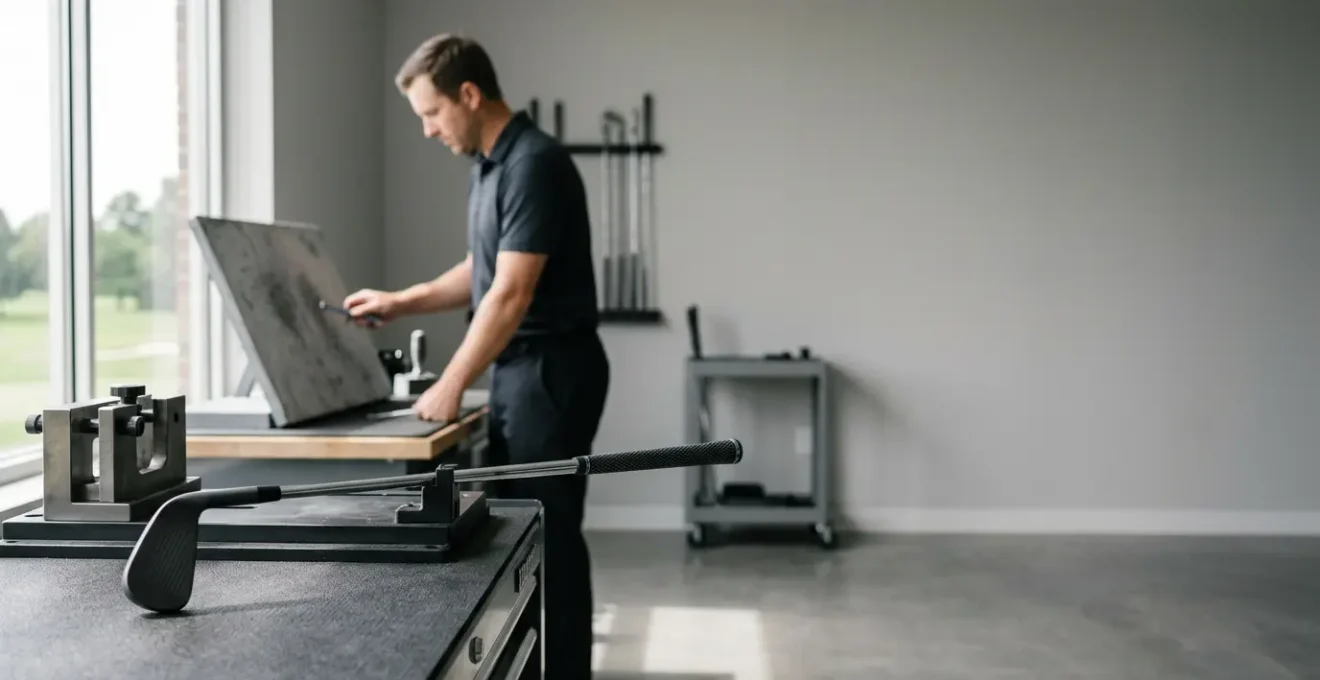
Correcting lie angle is about matching the club’s dynamic geometry to your swing at impact, not just conforming to a static measurement.
- An upright lie angle tilts the face plane leftward at impact, converting potential backspin into hook spin, a primary cause of pulled shots with short irons.
- Shaft flex, material, and even takeaway mechanics are interconnected variables that influence the club’s effective lie and trajectory at the moment of truth.
Recommendation: Use divot patterns and consistent ball flight misses as your primary diagnostic tools, and understand that off-the-rack ‘standard’ specifications are a common, often hidden, source of swing inconsistency.
You know the feeling. A perfectly struck iron shot that starts left and stays left. You check your alignment, your grip, your swing plane, yet the issue persists. Or perhaps you look back at your divot and see a familiar pattern: a trench deeper on the toe side or a gouge taken by the heel. For the dedicated golfer, these are frustrating symptoms of a problem that often goes misdiagnosed. The common advice—a static wrist-to-floor measurement or the simple « Sharpie test »—only tells a fraction of the story. These methods measure the club in a static, address position, ignoring the tremendous forces that alter its geometry during the swing.
The truth is that a golf club is not a rigid tool; it is a dynamic system. The effective lie angle at impact, or the « dynamic lie, » is a result of the complex interplay between the club’s static specifications, the shaft’s bending profile, and your unique biomechanical signature. Simply put, how you deliver the club to the ball is far more important than how it sits on the floor of a pro shop. Compensating for ill-fitting equipment by manipulating your swing is a recipe for inconsistency and, as we’ll explore, a potential pathway to injury.
This guide moves beyond the platitudes of standard club fitting. We will dissect the physics of impact, exploring not just the « what » but the « why » behind ball flight laws. We will examine how a component as seemingly separate as shaft material can influence your elbow health, and how a flawed takeaway can force the club into a position from which recovery is impossible. By understanding the golf club as an interconnected system, you can begin to diagnose the true root cause of your issues and unlock a new level of precision in your iron play.
To navigate this complex but crucial topic, we will break down the interconnected elements of a proper equipment setup. The following sections will guide you through the physics and practicalities of achieving a truly optimized iron game.
Table of Contents: A Systemic Approach to Iron Performance
- Why Does a Too-Upright Lie Angle Cause Hooks with Short Irons?
- How to Know if Your Shaft Is Too Stiff Based on Trajectory?
- Graphite or Steel: Which Shaft Material Reduces Elbow Vibration?
- The Standard Spec Mistake That Forces You to Compensate in Your Swing
- How to Gap Your Wedges to Cover All Distances Inside 100 Yards?
- Why Does an Inside Takeaway Cause an Over-the-Top Downswing?
- When to Stop Playing to Prevent « Golfer’s Elbow » from Becoming Chronic?
- How to Choose a Golf Ball Compression That Matches Your Driver Speed?
Why Does a Too-Upright Lie Angle Cause Hooks with Short Irons?
The relationship between an upright lie angle and a hooking or pulling ball flight is a fundamental principle of club fitting, yet the underlying physics are often misunderstood. It is not simply that the clubface « points left » at address. The effect occurs at a dynamic level, at the moment of impact, where the orientation of the entire face plane dictates the initial launch direction and subsequent spin axis. When a lie angle is too upright for a golfer’s delivery, the heel of the club digs into the turf first, causing the toe to close rapidly through impact. More significantly, the entire lofted face is tilted geometrically to the left (for a right-handed golfer).
This tilted impact plane is the critical factor. The golf ball will always launch perpendicular to the clubface’s plane at the point of maximum compression. With an upright lie, that launch direction is already left of the target line. Furthermore, the collision imparts a tilted spin axis. Instead of pure backspin, the gear effect creates a combination of backspin and side spin—specifically, hook spin. As legendary club designer Tom Wishon explains, « The ball would start left by the amount of the club loft, and backspin would be completely replaced by hook spin. » This effect is magnified on higher-lofted clubs, like short irons and wedges, because the face’s tilt has a more pronounced directional influence.
The consequences are significant and quantifiable. Comprehensive research demonstrates that a 4-degree upright lie angle error on a 46-degree pitching wedge can cause a shot from 120 yards to land an astonishing 26 feet left of the intended target. This is not a minor deviation; it is the difference between a birdie putt and a difficult up-and-down. For players struggling with a consistent pull, especially with their scoring clubs, investigating the dynamic lie angle is not just an option—it’s a necessity.
How to Know if Your Shaft Is Too Stiff Based on Trajectory?
While lie angle dictates the side-to-side direction, the golf shaft acts as the engine that governs trajectory and feel. A common fitting error is to assume a player with a high swing speed automatically requires an extra-stiff shaft. However, the shaft’s primary role is to manage loft and face angle delivery at impact. A shaft that is too stiff for the player’s load profile will resist bending, resulting in a lower dynamic loft and a noticeably low, often weak-feeling ball flight. If you feel you are launching the ball lower than your peers despite having good swing speed, your shaft stiffness is a prime suspect.
During the downswing, the shaft deflects or « droops » downward and also kicks forward toward the target. A properly matched shaft flex will kick forward at the optimal moment, adding dynamic loft and helping to square the clubface. A shaft that’s too stiff won’t kick forward enough, effectively de-lofting the club at impact. The player may experience a « boardy » or harsh feel, and the ball flight will be low with a tendency to fall to the right (for a right-hander) because the face has less time to rotate closed. Conversely, a shaft that is too flexible can lead to a high, ballooning trajectory with a propensity to hook, as it kicks too much and closes the face too early.
As described by equipment experts, « The shaft is considered the engine of the golf club, and your shaft has a huge influence on trajectory, shot shape, distance, and consistency. » Scientific analysis confirms this. A peer-reviewed study found that, on average, more flexible R-Flex shafts produced 5.82° of dynamic loft at impact, whereas less flexible X-Flex shafts produced only 3.84°. This nearly 2-degree difference in delivered loft is a massive factor in determining launch angle and peak height. Therefore, a low, unworkable trajectory is a clear geometric signal that your shaft may be overpowering your swing’s dynamics.
Graphite or Steel: Which Shaft Material Reduces Elbow Vibration?
The choice between graphite and steel shafts has long been debated, often simplified to a trade-off between lightweight speed (graphite) and consistent control (steel). However, a critical performance factor, especially for golfers concerned with joint health, is vibration dampening. When a golf ball is struck, a significant amount of energy is transferred. On a perfectly centered hit, most of this energy is efficiently transferred to the ball. On an off-center hit, however, a large amount of residual energy is converted into high-frequency vibrations that travel up the shaft and into the player’s hands, wrists, and elbows. This is where the material properties of the shaft become paramount.
Steel is a homogenous material that transmits vibrations very efficiently. While it provides crisp, clear feedback on strike quality, it does little to mitigate the harshness of a miss-hit. Graphite, on the other hand, is a composite material made of carbon fibers bonded by resin. This composite structure has inherent dampening properties, meaning it can absorb and dissipate vibrational energy much more effectively than steel. The vibrations are turned into negligible amounts of heat within the shaft’s layers instead of being transmitted to the golfer’s body.
The difference in performance is not subtle. In fact, NASA-derived research shows that vibrations in advanced graphite shafts can die out in as little as 0.6 seconds, compared to 15.7 seconds for older graphite designs. Steel shafts, by comparison, take at least twice as long as even conventional graphite to quell vibrations. For a golfer who plays or practices frequently, or for someone already managing conditions like tendonitis or arthritis, this cumulative exposure to vibration can be the difference between a comfortable round and chronic pain. Modern graphite iron shafts are no longer just for seniors seeking more speed; they are a technologically advanced solution for any player looking to reduce a major cause of physical stress in the golf swing.
The Standard Spec Mistake That Forces You to Compensate in Your Swing
One of the most pervasive myths in golf equipment is the existence of a true « standard » specification. When a golfer purchases a set of irons off the rack, they are buying a product built to that specific manufacturer’s standard lie angle, length, and loft. However, there is no industry-wide agreement on these numbers. Analysis of major brands shows that one company’s « standard » 7-iron lie angle can be a full degree or more different from another’s. This creates a minefield for the consumer and often forces them into making subconscious swing changes to accommodate the equipment, a process known as biomechanical compensation.
If a player’s irons are too upright, they might unconsciously raise their hands at impact or stand slightly farther from the ball to level the club’s sole through the hitting area. If they are too flat, they might drop their hands or crouch more. As the experts at Golf.com note, « attempting to shoehorn your swing into your club’s lie angles is a recipe for inconsistency. » These compensations are athletic instincts, but they are not repeatable under pressure. This is why a golfer might stripe it on the range but struggle on the course; the compensations break down when it matters most. The cost of an improper fit is clear; fitting data reveals that for every degree the lie angle is off, the ball will start approximately 4 yards offline.
The goal of a proper fitting is to eliminate the need for these compensations. The club should be tailored to the player’s natural, athletic, and repeatable motion—not the other way around. By identifying the tell-tale signs of a club-to-swing mismatch, a player can take the first step toward building a more consistent and less stressful golf swing.
Action Plan: Audit Your Club-to-Swing Mismatch
- Impact Pattern Analysis: Apply foot powder spray or impact tape to your clubface. After hitting 10 balls with a mid-iron, analyze the consistency of your strike location. A pattern away from the center is a major red flag.
- Divot Geometry Diagnosis: On a level grass tee, examine 10 divots. Note if they are consistently deeper at the toe (suggesting a lie angle that is too flat) or at the heel (too upright). A perfectly level divot is the goal.
- Ball Flight Correlation: Cross-reference your divot pattern with your typical miss. Do your toe-deep divots correspond with a consistent push or slice? Do your heel-deep divots match a pull or hook? The patterns must align.
- Static Measurement Baseline: Record your wrist-to-floor measurement while wearing golf shoes. Compare this to a manufacturer’s fitting chart online, but treat this data only as a starting hypothesis, not a final conclusion.
- Compensation Video Review: Film your swing from a down-the-line perspective. Look for subconscious adjustments through impact, such as a sudden lifting of the hands or an excessive drop in body height, which indicate you are fighting your equipment.
How to Gap Your Wedges to Cover All Distances Inside 100 Yards?
Nowhere is precision equipment more critical than in the scoring zone—inside 100 yards. Effective wedge gapping is the art of ensuring you have a club for every conceivable distance, eliminating awkward « in-between » shots. This process begins with understanding the loft of your pitching wedge (PW), which is the anchor for your entire wedge system. Modern iron sets have seen lofts become progressively stronger, with many PWs now at 43-45 degrees, whereas a traditional PW was closer to 47-48 degrees. Knowing this number is your non-negotiable first step.
From there, the goal is to create consistent yardage gaps, typically between 10-15 yards, by adding subsequent wedges. A common and effective strategy is to create 4-6 degrees of loft separation between each wedge. For example, if your PW is 45 degrees, a logical setup would be a gap wedge (GW) at 50 degrees, a sand wedge (SW) at 55 degrees, and a lob wedge (LW) at 60 degrees. This provides four distinct clubs for full swings inside your PW distance. It is also crucial to recognize that lie angles need to be consistent through your wedges. As noted by equipment analysts, « Wedges generally have a more upright lie angle than long irons, » to account for the more V-shaped swing arc used with these clubs. Ensuring your wedges are properly fit for lie angle is just as important as it is for your irons.
However, gapping isn’t just about full swings. A great short game player masters three distinct swing lengths with each wedge: a full swing, a three-quarter swing (hands to shoulder height), and a half swing (hands to waist height). A player with a 4-wedge system (PW, GW, SW, LW) who has mastered three swings with each now has 12 reliable distances at their disposal. By mapping out these yardages on the practice range and writing them down, you replace guesswork with a data-driven system. This eliminates the need for drastic deceleration or over-swinging on the course, leading to far greater distance control and confidence around the greens.
Why Does an Inside Takeaway Cause an Over-the-Top Downswing?
The « over-the-top » move is one of the most common and destructive swing faults in golf, causing steep attack angles, pulls, and slices. While it manifests in the downswing, its root cause is very often a flawed takeaway. Specifically, a takeaway where the clubhead is pulled too far inside the target line too early. This initial move sets off a biomechanical chain reaction that is nearly impossible to recover from. When the club is pulled inside, the body’s center of gravity and rotational center are disrupted. To get the club back to the ball, the golfer’s instinct is to reroute it from the top of the swing, which involves casting the hands and throwing the right shoulder « over the top » of the correct swing plane.
This is a classic example of action and reaction, governed by fundamental physics. The golf swing seeks a natural equilibrium and path. When the takeaway is too far inside, the club is in a position from which it cannot return to the ball on a neutral plane without a significant and athletic compensation. The over-the-top move is that compensation. It’s the body’s desperate attempt to create space and get the clubhead moving back toward the target. The result is a swing path that cuts across the ball from out-to-in, imparting slice spin and robbing the shot of power.
Understanding this sequence is crucial for any player battling this fault. As noted in sports science, the golf swing is a complex event governed by principles like « the kinetic link principle and the stretch-shorten cycle. » An inside takeaway breaks this kinetic link. The proper takeaway involves a « one-piece » movement of the hands, arms, and shoulders together, keeping the clubhead outside the hands until the club is parallel to the ground. This maintains the club on the correct plane and « in front » of the body’s rotation, allowing it to simply drop back onto that same plane in the downswing without the need for a dramatic rerouting. Fixing the first two feet of your swing is often the key to fixing the entire motion.
When to Stop Playing to Prevent « Golfer’s Elbow » from Becoming Chronic?
Medial epicondylitis, commonly known as « golfer’s elbow, » is an inflammation of the tendons on the inside of the elbow. It’s an overuse injury, but one that is significantly exacerbated by poor technique and, critically, ill-fitting equipment. The primary mechanism of injury is the repeated stress placed on the forearm tendons, particularly during impact. A major contributor to this stress is the shock from off-center hits. As discussed, an improper lie angle is a leading cause of toe or heel strikes. These miss-hits are not just damaging to your score; they are physically damaging to your body.
Case Study: The Link Between Lie Angle and Joint Stress
Extensive club fitting research has demonstrated a direct correlation between impact location and harmful vibrations. When a club’s lie angle is incorrect for the golfer’s swing, it forces the impact to occur on the heel or toe. These off-center strikes are the primary generators of high-frequency shock that travels up the shaft. A properly fitted lie angle, which promotes centered contact, ensures that the maximum amount of energy is transferred to the golf ball. This minimizes the residual energy that is converted into vibration, thereby reducing the cumulative stress on the player’s elbow, regardless of what shaft material is being used.
The key to preventing golfer’s elbow from becoming a chronic, debilitating condition is to listen to your body and recognize the early warning signs. The initial symptom is often a dull ache or tenderness on the inner part of your elbow, which may sharpen during or after a round. If you feel this pain, the immediate course of action is to stop playing. Pushing through the pain will only worsen the inflammation and can lead to micro-tears in the tendon, significantly prolonging recovery. Rest, ice, and anti-inflammatory medication are the first line of defense. Ignoring these signs and continuing to play with equipment that promotes miss-hits is the fastest way to turn an acute issue into a chronic one that may require months of rehabilitation.
Key Takeaways
- Dynamic Lie is King: Your static, address-position lie angle is almost irrelevant; the angle delivered at the moment of impact is the geometric reality that dictates ball flight.
- Clubs Are a System: The clubhead, shaft, and even the ball interact. Changing shaft flex can alter dynamic lie and launch, and an incorrect lie angle can lead directly to joint-damaging vibrations.
- Fit for Performance and Prevention: An incorrect lie angle not only sabotages accuracy by forcing compensations but also generates harmful vibrations on off-center hits, a leading contributor to injuries like golfer’s elbow.
How to Choose a Golf Ball Compression That Matches Your Driver Speed?
The golf ball is the only piece of equipment you use on every single shot, yet it’s often the last thing a player considers in the fitting process. Choosing the right ball is the final link in the systemic approach to optimization. One of the most important metrics for ball selection is compression, which is essentially a measure of how much the ball deforms at impact against the clubface. A lower compression ball (typically rated 70 or below) deforms more easily and is suited for players with slower to moderate swing speeds (generally under 95 mph with the driver). A high compression ball (90 or above) is firmer and requires a higher swing speed to achieve optimal energy transfer.
Using a ball that doesn’t match your speed has significant consequences. A player with a slower swing using a high-compression tour ball will be unable to sufficiently compress it, resulting in a harsh feel and a significant loss of distance. It’s like trying to bounce a basketball that’s overinflated. Conversely, a high-speed player using a very low-compression ball may « over-compress » it, leading to a loss of control and potentially less distance than a firmer, properly matched ball. The goal is to match the ball’s « engine » to the speed you can generate, ensuring maximum rebound effect—or Coefficient of Restitution (COR)—for your swing.
This entire discussion loops back to the central theme of centeredness. The benefits of a perfectly matched golf ball are only realized with a centered strike. As we’ve established, an incorrect lie angle is a primary cause of off-center hits. The penalty for these misses is severe; equipment research demonstrates that a ball impact just 0.5 inches off-center results in a 7% carry distance loss. An impact 1 inch from the sweet spot causes a staggering 14% loss. Therefore, before you can truly optimize your ball performance, you must first ensure your equipment is promoting a centered strike. The golf ball is the final piece of the puzzle, not the first.
By understanding each of these components—from lie angle and shaft dynamics to biomechanics and ball construction—not as isolated variables but as parts of a single performance system, you can move beyond guesswork. The path to better iron play is paved with a precise, holistic understanding of your equipment. To unify these elements and build a set of clubs that truly matches your unique swing, the logical next step is to seek a comprehensive analysis from a qualified club fitter.