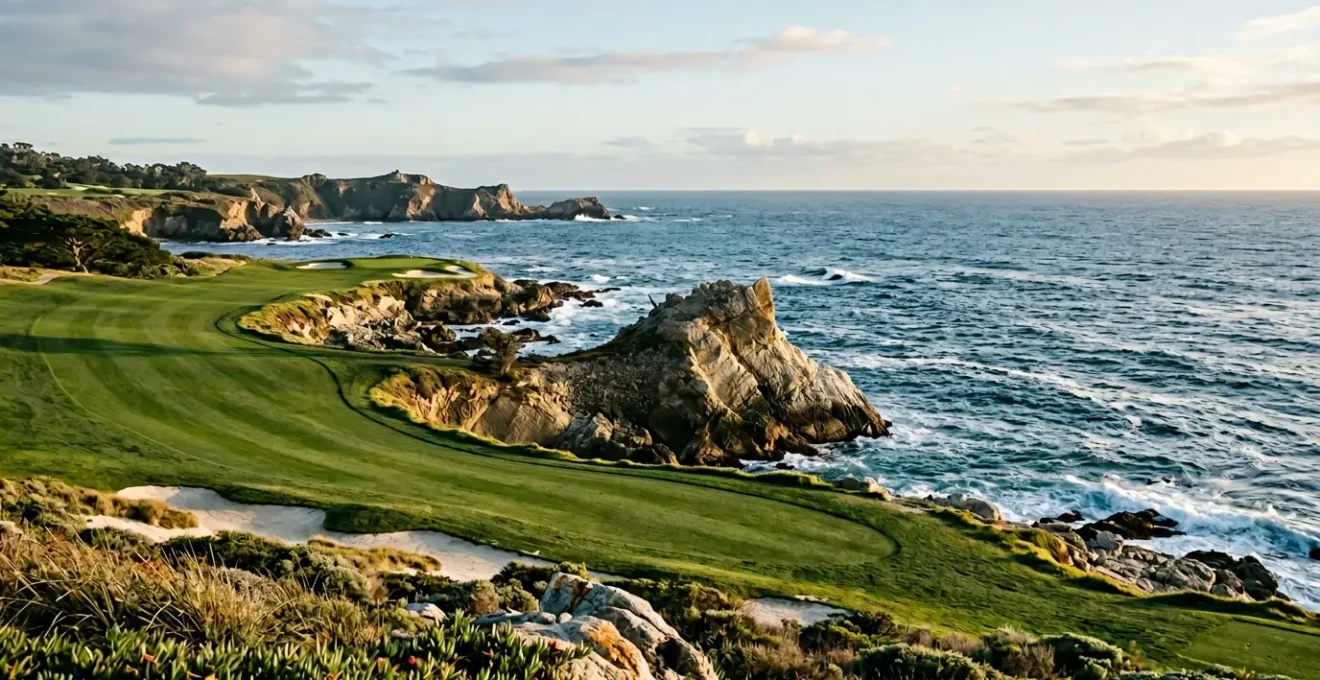
Justifying the Pebble Beach green fee requires viewing it not as a simple purchase, but as an investment in a complex ‘value stack’ of non-replicable assets and carefully engineered experiences.
- The price includes the immense, ongoing cost of preserving the course against natural forces like coastal erosion.
- Access is a manufactured commodity, with the resort’s ‘stay-to-play’ policy creating the scarcity that underpins its premium value.
Recommendation: Evaluate the fee by deconstructing its components—from its unique atmospheric conditions to the value-per-minute of a deliberately paced round—to determine if this portfolio of experiences aligns with your personal definition of ‘worth it.’
For any serious golfer, the question is both a daydream and a genuine financial dilemma: is a single round at Pebble Beach Golf Links truly worth the $600+ green fee? Standard justifications often point to the seven U.S. Opens, the celebrity-filled Pro-Am, and the breathtaking beauty of its cliffside holes. While true, these points only scratch the surface. They fail to address the core of the issue in a way a luxury travel value analyst would: what, precisely, are you paying for? The answer isn’t just a walk on hallowed ground; it’s an investment in a meticulously crafted portfolio of tangible and intangible assets.
Most analyses stop at « it’s a bucket-list experience. » This one does not. We will move beyond the platitudes to deconstruct the fee. The key to justifying this significant expense lies in understanding its unique ‘value stack’—a layered combination of manufactured scarcity, the depreciation of a non-replicable natural asset, the operational burden of its iconic status, and the quantifiable price of a permanent memory. It’s about recognizing that you’re not just paying for 18 holes of golf; you’re buying into a complex economic and environmental ecosystem.
This article will guide you through that value stack, component by component. We will analyze how everything from coastal erosion and morning fog to the notoriously slow pace of play contributes to the final price tag. By the end, you will have a clear, analytical framework to decide not if Pebble Beach is ‘good,’ but if its unique, multi-faceted value proposition is the right investment for you.
To fully understand the components that make up this iconic golf experience, we will explore the key factors that influence its cost and character. The following sections break down everything from environmental threats to on-course strategy.
Summary: Deconstructing the Value of America’s Premier Golf Experience
- Why Does Coastal Erosion Threaten the Future of the 18th Hole?
- How to Navigate the Resort Stay-to-Play Requirement for Tee Times?
- Pebble Beach or Spyglass Hill: Which is the Better Test of Golf?
- The Weather Mistake: Assuming Sunshine in July on the Monterey Peninsula
- How to Handle a 6-Hour Round Without Losing Your Rhythm?
- Ocean Waves or Forest Silence: Which Soundscape Promotes Better Rhythm?
- Why Does the Ball Fly 10% Shorter at Sea Level in the Morning?
- How to Adjust Your Club Selection for Heavy Pacific Air?
Why Does Coastal Erosion Threaten the Future of the 18th Hole?
A significant, often overlooked, component of the Pebble Beach green fee is the cost of simply keeping the course from falling into the Pacific Ocean. The iconic 18th hole, a curving par-5 along Stillwater Cove, is not a static landscape but a battleground against nature. A portion of your fee is a direct contribution to an immense and perpetual preservation effort. This isn’t just maintenance; it’s a fight against the very geology that makes the course legendary. The value here is in playing something that is actively being saved.
For decades, the coastline has been receding. Historical data shows that from the 1940s to the mid-1990s, the property was losing an average of 3 inches per year to coastal erosion. This may sound minimal, but over time it represents a catastrophic threat. Ted Horton, a former Pebble Beach Company Vice President, once starkly noted the risk: « We were going to lose 30 or 100 feet and there was a question that we’d ever get it back. » This existential threat necessitated massive capital investment.
The solution was the 18th Hole Seawall Preservation Project, a major engineering feat approved by the California Coastal Commission. The project involved constructing steel-reinforced concrete seawalls disguised as natural rock formations to protect the fairway and the adjacent overlook. This wasn’t a one-time fix; the permit itself requires constant monitoring and mitigation measures, including paying for the 6,456 cubic yards of sand the wall is projected to prevent from naturally supplying the coastline over its 20-year term. Therefore, the green fee isn’t just for the view; it’s for the multi-million dollar, environmentally complex project that guarantees the view will still be there.
How to Navigate the Resort Stay-to-Play Requirement for Tee Times?
The second pillar of the Pebble Beach value stack is manufactured scarcity. While the course is public, access is tightly controlled through a « stay-to-play » model that functions as the primary gatekeeper. For most, securing a coveted tee time requires booking a multi-night stay at one of the resort’s properties, such as The Lodge at Pebble Beach or The Inn at Spanish Bay. This policy intentionally transforms the tee time from a simple booking into the capstone of a luxury travel package.
This strategy has a clear financial impact. An analysis by Golf.com reveals that the true entry price for a guaranteed round isn’t just the green fee. For a single golfer, a total package of at least $2,465 for a guaranteed tee time is the realistic minimum, factoring in a two-night stay. This business model ensures that the course is not overwhelmed and that the experience remains exclusive, but it fundamentally ties the golf to a larger, more significant investment. You are not just buying a round; you are buying a temporary membership into one of the world’s most exclusive resorts.
However, for the determined golfer willing to trade certainty for a lower cost, there is a path. Non-resort guests can attempt to book a tee time exactly 24 hours in advance by calling the pro shop. This method is not guaranteed and favors smaller groups, like singles or twosomes, especially during the off-peak season from November to February. Success requires precision and flexibility, but it uncouples the green fee from the mandatory resort stay, offering a glimpse of the course for its standalone price. This high-risk, high-reward option underscores the core principle: at Pebble Beach, you pay a premium for certainty.
Pebble Beach or Spyglass Hill: Which is the Better Test of Golf?
When analyzing the value of Pebble Beach, it’s essential to define what « test of golf » you are paying for. Many assume the high fee correlates directly with supreme difficulty. However, a comparison with its highly respected sister course, Spyglass Hill, reveals a more nuanced value proposition. While both are championship venues, they test different skills. Spyglass is arguably the purer, more relentless test of ball-striking, whereas Pebble Beach tests your ability to manage emotion, strategy, and spectacular distraction.
The data from the PGA Tour’s AT&T Pebble Beach Pro-Am, where professionals play both courses, is telling. Despite its iconic status, Pebble Beach is often the more scoreable of the two. In one recent event, where PGA Tour scoring data shows an average of 2.18 strokes under par at Pebble, players only averaged 1.42 strokes under par at Spyglass Hill. This suggests you are not paying $600+ for the world’s most difficult course. You are paying for a unique kind of challenge, one interwoven with history and breathtaking visuals that can be as mentally taxing as any narrow fairway.
As major champion Jon Rahm explains, Spyglass demands precision above all else: « Spyglass is a golf course where ball striking is really key. It gets a little narrow, you have trees in the way, and you have very undulated greens with small areas to put the pins. » Its challenge is relentless and technical, a stark contrast to Pebble’s wide-open coastal holes.
This dense Monterey pine forest corridor framing a Spyglass Hill golf hole shows the dramatic elevation changes and the precision it demands.
The value of Pebble Beach, therefore, lies not in its raw difficulty score but in its unparalleled setting. You are paying for the drama of hitting a shot over the ocean on hole 7 or the heroic approach on hole 8. It’s a test of focus amid overwhelming beauty, a component that Spyglass, for all its brilliance, cannot replicate in the same way.
The Weather Mistake: Assuming Sunshine in July on the Monterey Peninsula
Part of the Pebble Beach ‘product’ is its unique and often unpredictable « atmospheric terroir. » A common mistake for visitors is assuming that a summer booking guarantees a sun-drenched round. In reality, the Monterey Peninsula’s most famous weather feature, the marine layer, is most prominent in the summer. Paying the premium fee means accepting, and even appreciating, this atmospheric uncertainty as part of the authentic experience.
As Pebble Beach Resorts officially advises its visitors, « The summer months can be accompanied by a morning fog, with the weather heating up when the marine layer burns off in the afternoon. » This isn’t an occasional phenomenon; it’s the standard climate pattern. The fog is formed when the cool air over the Pacific Ocean is pulled inland by the heat of the California valleys. This creates a dense, low-hanging blanket of moisture that hugs the coastline, dramatically altering the look, feel, and playability of the course.
This marine layer is not a uniform inconvenience. It ebbs and flows, sometimes shrouding the course in a thick mist that obscures flagsticks, only to burn off and reveal stunning vistas within a matter of holes. This dynamic quality is part of what makes each round unique. You might play the iconic 7th hole with a clear view of the ocean, while another group an hour later might be hitting into a wall of white. This unpredictability is a core feature, a natural element that has shaped championships and defines the coastal playing experience. You are paying for a round where the course itself can change character from one hour to the next.
How to Handle a 6-Hour Round Without Losing Your Rhythm?
The pace of play at Pebble Beach is notoriously slow, with rounds frequently stretching to six hours. For many golfers, this would be a deal-breaker. However, within the value analyst’s framework, this « negative » can be reframed as a positive: you are maximizing your time on one of the world’s most expensive pieces of golfing real estate. Instead of a flaw, the extended duration becomes a feature, offering more time to soak in the environment you’ve paid a premium to access.
A simple calculation puts this in perspective. At a $600 green fee, a six-hour (360-minute) round means you are paying approximately $1.67 per minute for the experience. A faster round would actually give you less value on a per-minute basis. The key is to shift your mindset from « getting through the round » to « inhabiting the experience. » Use the waits on tees to take photos, observe the ocean wildlife, or simply appreciate the history under your feet. This is not your typical Saturday morning round; it’s an all-day excursion.
The slow pace is also a byproduct of the course’s design and its diverse clientele. As the resort itself notes, the greens are a major challenge: « The average Pebble Beach green is just 3,500 square feet, the smallest on the PGA TOUR. » These tiny, undulating targets demand precise approaches and create difficult up-and-downs, slowing down play for golfers of all skill levels. When you combine this design feature with a mix of once-in-a-lifetime visitors, corporate groups, and serious players, a deliberate pace is inevitable. Handling it is a matter of accepting it as a fundamental part of the value proposition.
Ocean Waves or Forest Silence: Which Soundscape Promotes Better Rhythm?
The intangible assets of the Pebble Beach ‘value stack’ are just as important as the tangible ones. A critical, yet rarely analyzed, component is the soundscape. The constant, rhythmic crash of Pacific waves provides a natural metronome that is fundamentally different from the experience at an inland course. You are paying for an auditory environment that is as unique and dramatic as the visual one. For some, this sound can enhance rhythm and focus; for others, it’s another beautiful distraction to manage.
Consider the contrast with a course like Spyglass Hill, where play moves from the ocean into the quiet of the Del Monte Forest. There, the dominant sound is often silence, broken only by the wind in the Monterey pines or the sharp crack of a well-struck iron. This cathedral-like quiet promotes a different kind of internal focus. At Pebble Beach, especially on holes 4 through 10 and 17-18, the external environment is an active participant. The sound of the ocean is a constant presence, a powerful reminder of the « greatest meeting of land and water in the world, » as Tiger Woods famously described it.
This is the sensory premium you are paying for. It is what Tiger Woods meant when he said, « Pebble is a piece of sacred ground… This course was heaven designed—just the way it fits on the land. » That fit is not just visual; it is auditory and elemental. Whether the sound of waves helps or hinders your personal rhythm is subjective, but its presence is a non-replicable feature of the experience. It’s the soundtrack to a round of a lifetime.
The Pacific Ocean waves crashing against the rocky Pebble Beach coastline create the signature soundscape that defines the round.
The choice is between the focused silence of a forest and the epic, rhythmic grandeur of the sea. At Pebble, your fee secures the latter, an immersive sensory experience that transcends a simple game of golf.
Why Does the Ball Fly 10% Shorter at Sea Level in the Morning?
The final component of the course’s ‘atmospheric terroir’ is a matter of physics: the air itself. Golfers playing Pebble Beach, especially during a foggy morning, will quickly discover that the golf ball doesn’t travel as far as it does at their home course. A well-known rule of thumb on the Monterey Peninsula is to expect the ball to fly roughly 10% shorter in the heavy, moist sea-level air. This isn’t a myth; it’s a scientific reality that adds another layer of strategic challenge to the round.
This phenomenon is a direct result of the marine layer. The air, saturated with cool moisture from the Pacific, is denser than the warm, dry air found at inland or high-altitude courses. Dense air creates more drag on the golf ball during its flight, reducing both its carry distance and overall yardage. This effect is most pronounced in the morning when the marine layer is thickest and temperatures are cool.
This « heavy air » is an integral part of the course’s defense. It forces players to second-guess their club selection and trust that a 7-iron might be required for a shot that would normally call for an 8- or 9-iron. It’s a natural element that has confounded professionals in major championships for decades. When you pay to play Pebble Beach, you are paying for a test that includes overcoming these unique environmental conditions. It’s a challenge that cannot be simulated on a driving range or replicated at most other courses in the world, making it a valuable and distinct part of the overall experience.
Key Takeaways
- The Pebble Beach green fee is a ‘value stack’ investment, not just a purchase, covering preservation, scarcity, and unique experiences.
- A significant portion of the cost funds the ongoing engineering battle against coastal erosion to preserve the iconic layout.
- The slow, six-hour pace of play can be re-framed as maximizing your ‘cost-per-minute’ on world-famous golfing real estate.
How to Adjust Your Club Selection for Heavy Pacific Air?
Ultimately, justifying the investment in a round at Pebble Beach culminates in your ability to successfully navigate its unique challenges. The final piece of the value puzzle is mastering the art of club selection in its specific environment. This is where the entire ‘value stack’—the coastal setting, the unpredictable wind, the elevation changes, and the heavy air—converges into a series of practical decisions on the course. Successfully adjusting is the key to unlocking the full enjoyment of the experience you’ve paid for.
This is the test that makes it a « bucket list place to win, » as 2017 AT&T champion Jordan Spieth described it. Winning your personal battle against the course requires a strategic departure from standard yardages. You must learn to play with your eyes and your instincts, factoring in the multiple environmental variables that are constantly in flux. It’s a dynamic puzzle that changes with every shift in the wind and every passing cloud.
Adapting your game is not just about hitting the ball well; it’s about thinking your way around the course. It involves trusting that you need two extra clubs on your approach into a stiff ocean breeze or taking less club on a downhill shot that feels longer than it is. This mental engagement is the ultimate return on your investment, transforming you from a tourist into an active participant in the Pebble Beach legend.
Action Plan: Strategic Club Selection for Pebble Beach Conditions
- Monitor on-site weather station data for wind direction and speed before your round, as coastal winds frequently disrupt normal yardages.
- Account for elevation changes unique to coastal cliffside holes—shots to elevated greens require additional club, downhill approaches need less.
- Factor in the ‘heavy air’ of morning marine layer conditions by taking one to two extra clubs for approach shots.
- On iconic holes like the 109-yard par-3 7th, expect to use anywhere from an 8-iron to a 9-iron depending on wind, despite the short distance.
- Adjust your pre-shot routine to include visual wind indicators like flag movement, ocean spray direction, and cypress tree sway patterns.
Ultimately, the decision to play is a personal one. By understanding the intricate value stack—from the fight against erosion to the physics of heavy air—you are no longer just asking if the view is worth the price. You are making an informed investment decision. Use this value framework to determine if the investment aligns with your personal definition of a round of a lifetime.