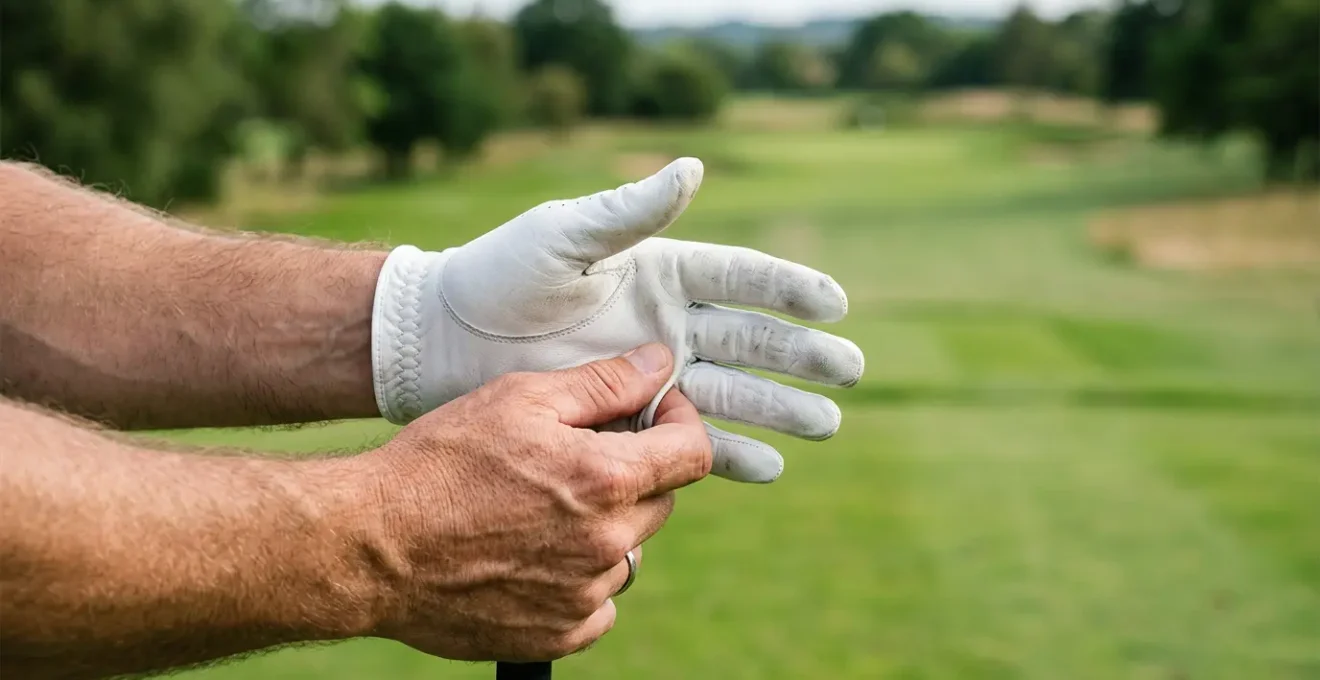
A perfectly sized golf glove is not a comfort accessory; it’s a high-performance interface that translates directly to lower scores by improving your sensory connection to the club.
- A snug, « second-skin » fit is critical because it reduces subconscious grip tension, which directly unlocks greater clubhead speed.
- Excess material, especially in the palm or fingertips, creates micro-movements that cause friction blisters and a loss of clubface control at impact.
Recommendation: Use the « Pinch Test » at your fingertips and across the palm to verify a true performance fit, and analyze your glove’s wear patterns to get a free diagnosis of your grip flaws.
That golf glove crumpled at the bottom of your bag, with a hole in the palm and a slick, shiny thumb, is more than just a piece of worn-out equipment. It’s a data-rich story of your connection to the golf club—a story often defined by compromise and misunderstanding. Most golfers wear a glove until it disintegrates, grabbing a replacement off the rack based on a loose sense of size. They are told a glove should « fit like a second skin, » but this advice is dangerously vague and misses the point entirely.
The common approach is to buy gloves that are too large, leading to a cascade of performance-killing compensations. The subtle slipping and bunching forces you to grip the club tighter, introducing tension that strangles swing speed and destroys feel. You develop blisters not because of hard work, but because of friction caused by an improper fit. But what if the goal wasn’t just to prevent blisters? What if the correct fit is a direct line to unlocking more swing speed with less effort? This guide reframes the golf glove not as a disposable accessory, but as a critical sensory interface—a piece of performance equipment designed to optimize the connection between your hands and the clubface. We will deconstruct the fit, material, and maintenance to transform your glove from a liability into a true competitive advantage.
Summary: The definitive guide to golf glove fitting for enhanced grip and performance
- Why Does a Tacky Glove Allow You to Swing Faster with Less Tension?
- How to Perform the « Pinch Test » to Check for Proper Glove Fit?
- Cabretta Leather or Synthetic: Which Glove Survives High Humidity Best?
- The Wear Pattern Mistake That Reveals a Flawed Grip Technique
- How to Rotate Gloves During a Round to Maintain Peak Grip?
- One-Plane or Two-Plane: Which Swing Model Suits Your Body Type?
- The Maintenance Mistake: Leaving Salt Air on Your Forged Irons
- How to Interpret Slope and Rating to Choose the Right Tees?
Why Does a Tacky Glove Allow You to Swing Faster with Less Tension?
The connection between a tacky, well-fitting glove and increased swing speed is not a matter of marketing; it’s a principle of biomechanics. The primary benefit of a secure grip interface is the permission it gives your hands to relax. When your brain senses the club is secure and won’t slip, it doesn’t need to engage in a « death grip. » This reduction in grip pressure is the key to unlocking speed.
Excessive tension in the hands and forearms acts as a speed brake. It restricts the fluid motion of the wrists and prevents the efficient transfer of energy from your body’s rotation to the clubhead. As golf biomechanics researcher Sasho MacKenzie explains, this is a critical energy leak.
A lighter grip pressure often translates to higher clubhead speed because it allows you to transfer the speed you’ve generated in your body and hands to the clubhead. If you hold the grip really tight, the speed you’ve created never reaches the clubhead.
– Sasho MacKenzie, Golf Digest
This isn’t just theory. When you have grip integrity, you can hold the club lightly and still maintain full control. A tacky, correctly sized glove provides this integrity, allowing you to minimize tension and maximize the whip-like action that generates clubhead speed. This is the secret that separates elite ball-strikers from amateurs: they swing faster by holding on lighter, and a perfect glove is the foundation of that confidence.
How to Perform the « Pinch Test » to Check for Proper Glove Fit?
The « like a second skin » mantra fails because it’s subjective. The « Pinch Test » provides an objective, tactile method for diagnosing fit. The startling reality is that a vast number of players are getting this wrong. In fact, according to FootJoy’s glove fitting data, upwards of 50% of golfers are estimated to be wearing the wrong glove size, with the majority choosing one that is too large. This excess material is the root cause of both blisters and inconsistency.
A properly fitted glove should be snug across the palm and fingers, leaving no room for the material to wrinkle or fold during the swing. Any excess fabric creates a layer of instability between your hand and the grip, forcing you to squeeze tighter to prevent the club from twisting. To find this perfect fit, you must go beyond simply trying it on; you must put it to the test.
The image above demonstrates the critical test point. A proper fit means there should be almost no extra material to pinch at the fingertips or across the knuckles. This ensures the glove is acting as a true interface, transmitting every bit of sensory information from the club grip directly to your hand. It’s time to stop guessing and start measuring with a systematic audit.
Your 5-Point Glove Fit Audit
- Fingertip Pinch Test: With the glove on, try to pinch the material at the very tip of your index and middle fingers. There should be no more than a tiny amount of excess material. If you can pinch a noticeable flap, the glove is too long.
- Palm Void Test: Make a tight fist. Look at your palm. A perfectly fitted glove will be taut and smooth. If you see significant wrinkles or an « air pocket, » the glove is too wide, which will cause friction and blisters.
- Velcro Tab Rule: Fasten the closure tab. It should only cover about 75-80% of the landing pad (the fuzzy part). This leaves about a quarter-inch of Velcro exposed, allowing for adjustment as the leather stretches during play. If the tab covers the entire pad, the glove is too big.
- Finger Twist Check: Grip an imaginary club and try to twist the material around your index finger. If the glove’s finger rotates easily around your own, the finger diameter is too large and will compromise your control of the clubface.
- Dynamic Swing Simulation: Grip your own club and take a few slow backswings. Pay close attention to the base of your palm and fingers. If you feel any material bunching up, that’s a sign of a poor fit that will only be exaggerated at full speed.
Cabretta Leather or Synthetic: Which Glove Survives High Humidity Best?
The choice between natural Cabretta leather and modern synthetic materials is often framed as a simple trade-off: feel versus durability. However, the introduction of a single variable—humidity—completely changes the performance equation. In hot, humid, or rainy conditions, a glove’s ability to maintain its grip coefficient and manage moisture becomes paramount.
Cabretta leather, prized for its softness and exceptional tactile feedback, has a distinct saturation point. Once it becomes soaked with sweat or rain, its natural tackiness is lost, and it can become slick and unreliable. Synthetics, on the other hand, are often engineered specifically for moisture management, using materials and technologies designed to wick sweat away and maintain grip even when wet. The following comparison highlights the critical differences when playing in humid environments.
| Performance Factor | Cabretta Leather | Synthetic |
|---|---|---|
| Grip in Dry Conditions | Excellent – Natural tackiness when dry | Good – Consistent but less tactile |
| Grip in Humid/Wet Conditions | Good until saturation point, then loses tackiness | Excellent – Engineered to wick moisture and maintain consistent grip coefficient |
| Breathability | Superior – Natural pores allow air circulation | Limited – Traps heat and sweat against skin |
| Feel & Feedback | Exceptional – Thin profile transmits sensory information | Moderate – Creates barrier that dulls feedback |
| Durability (Humid Climate) | Lower – Requires careful air-drying to prevent cracking | Higher – Can often be machine washed, more resilient |
| Maintenance | Higher – Must air-dry away from heat after moisture exposure | Lower – Easy to clean and maintain |
The modern solution for many golfers is the hybrid glove. As seen in MyGolfSpy’s 2025 testing, where the FootJoy SciFlex was named ‘Best Synthetic,’ these designs offer the « best of both worlds. » They combine a supple Cabretta leather palm, placed where the sensory connection to the club is most vital, with a synthetic or mesh backing. This construction provides the tactile feedback necessary for feel shots while leveraging the superior breathability and moisture management of synthetics across the back of the hand, keeping it cooler and drier in challenging climates. This approach treats the glove as an engineered system, not a single-material product.
The Wear Pattern Mistake That Reveals a Flawed Grip Technique
A worn-out golf glove is not a sign of failure; it is a diagnostic chart. Before you throw it away, you must learn to read the story it tells. The location of scuffs, shiny spots, and eventually holes, provides a precise, undeniable map of your grip pressures and swing flaws. Ignoring this data is a massive mistake, as it offers free, personalized feedback that can guide your practice. A prominent physical therapist warns that these patterns can even predict injury.
If you keep wearing out the leather in the heel pad of your golf glove, you’re a prime candidate for wrist, elbow and shoulder injuries.
– Ralph Simpson, AGX Golf
Most golfers assume a hole in the palm is normal « wear and tear. » In reality, it’s a clear indication that the club is held too much in the palm instead of the fingers, a fundamental flaw that kills power and consistency. By learning to perform this « glove forensics, » you can identify and correct bad habits before they become ingrained, or worse, lead to injury.
Here is a breakdown of the most common wear patterns and the swing diagnoses they reveal:
- Palm Wear Pattern: This is a major red flag. It indicates your grip is either far too tight or, more likely, the club is sitting in the lifeline of your palm instead of resting in the fingers. This palm-based grip prevents proper wrist hinge and is a massive power leak.
- Heel Pad Wear: A hole or significant wear on the heel pad of your hand is one of the most common and damaging patterns. It is caused by re-gripping the club during the transition from backswing to downswing, or by the club handle rubbing against the pad. This indicates a loss of connection and a failure to rotate through impact, often leading to slices and injuries.
- Thumb Wear (Excessive): A hole on the thumb points to excessive pressure from your trail hand’s thumb pushing down on the club, or a poor connection between your hands. This creates unwanted tension and can lead to inconsistent clubface control.
- Index Finger Wear: If you use an overlapping grip, wear on the lead hand’s index finger often means the pinkie of your trail hand is digging into the knuckle. It can also indicate the club is twisting in your hands through impact.
How to Rotate Gloves During a Round to Maintain Peak Grip?
Even the most perfectly fitted, premium Cabretta leather glove has a nemesis: moisture. Whether from sweat on a hot day or humidity in the air, moisture saturates the leather, compromising its tackiness and structural integrity. The professional’s solution to this problem is not to find a magic glove, but to implement a systematic rotation strategy. This isn’t just about making gloves last longer; it’s about ensuring you have peak grip performance on every single shot, from the first tee to the 18th green.
Simply stuffing a damp glove into a crowded bag pocket between shots is a recipe for disaster. The trapped moisture has nowhere to go, accelerating the breakdown of the leather. A proactive rotation system allows each glove the crucial time it needs to air out, dry, and restore its natural tackiness. According to FootJoy’s glove care guidelines, rotating between multiple gloves extends the life of each by giving them adequate time to recover. The key is a disciplined approach.
Adopting a simple « Three-Glove System » can radically improve your on-course performance and the longevity of your equipment:
- Glove 1 (Primary): This is your main gamer for all full shots. Start the round with this fresh glove.
- Glove 2 (Secondary): This glove is the backup, ready to be rotated in. After 3-6 holes (depending on humidity), swap out the primary glove for this one.
- Glove 3 (Feel Glove): This is often an older, softer glove designated exclusively for putting and the most delicate chips around the green. You remove your primary glove and use this one to maximize sensory feedback where power is not a factor.
The most critical part of this system is the « air-out » technique. When a glove is not in use, do not put it in your pocket or bag. Instead, attach it by its Velcro tab to the frame of your golf cart or the outside of your bag. This exposure to airflow is essential for moisture evaporation. Framing the act of switching to a fresh, dry glove can also serve as a powerful psychological reset button before a crucial tee shot, reinforcing the link between a confident feel and a committed swing.
One-Plane or Two-Plane: Which Swing Model Suits Your Body Type?
The way your glove wears out is not just a reflection of your grip, but also of your entire swing’s architecture. Understanding whether you have a one-plane or two-plane swing is crucial because each model imposes vastly different forces and pressures on the glove interface. Choosing the right glove—and diagnosing its wear—requires knowing which type of swing you have.
A one-plane swing, often associated with players who rely on body rotation (think Matt Kuchar or Ben Hogan), keeps the club on a single plane throughout the swing. This creates significant rotational or « shear » force. For these players, the glove is constantly being twisted. This leads to characteristic wear on the side of the index finger and thumb area as the material fights to stay in place. For a one-planer, a snug-fitting glove with high torsional stability is paramount to prevent the glove from rotating around the hand and compromising clubface control.
Conversely, a two-plane swing utilizes a more distinct vertical lift with the arms in the backswing and a subsequent « dropping » into the slot (think Jack Nicklaus or Justin Thomas). This motion places intense, repeated pressure on the heel pad of the lead hand during the wrist-set phase and at the top of the swing. The wear pattern is therefore highly concentrated in this one spot. A two-plane swinger needs a glove that can withstand this focused pressure, often benefiting from models with a reinforced or padded palm and heel area.
This distinction turns glove selection into a highly personalized process. A one-planer gripping too loosely with a poorly fitted glove will find the club twisting uncontrollably in their hands at the top. A two-planer with a thin, unreinforced glove may find the pressure on their heel pad uncomfortable or even painful, and will wear through gloves at an alarming rate. Your swing model dictates the specific demands you place on the glove, and the right glove is one that is built to meet those demands head-on.
The Maintenance Mistake: Leaving Salt Air on Your Forged Irons
The same corrosive element that ruins a set of pristine forged irons—salt—is silently destroying your golf gloves from the inside out. But in this case, the source isn’t ocean air; it’s your own perspiration. The salt in your sweat is the primary culprit in turning a soft, supple Cabretta leather glove into a stiff, cracked, and useless piece of cardboard. Proper post-round maintenance is not a luxury; it is essential to preserving the sensory interface of your glove.
When you finish a round, your glove is laden with salt and oils. If you simply crumple it up and toss it in your bag, a destructive process begins. As the glove dries, the salt crystals left behind leach the natural moisture and emollients from the leather’s fibers. This makes the leather brittle, reduces its natural tackiness, and ultimately causes it to crack and tear. A stiff glove forces you to grip harder, re-introducing the very tension you’ve worked to eliminate.
Just as you would wipe down your clubs, you must « detox » your glove after every use. A simple routine can double or triple the life of a premium glove:
- Wipe Down Leather: Immediately after the round, use a slightly damp cloth to gently wipe the entire surface of a leather glove. This removes the surface layer of salt and grime before it can set in.
- Air-Dry Naturally: The most crucial step. Allow the glove to air-dry flat, away from any direct heat source or sunlight. Never put it on a radiator or use a hairdryer. This slow drying process allows the leather to retain its natural suppleness.
- Clean Your Grips: Dirty, grimy club grips act like sandpaper on your glove’s palm. At least once a month, scrub your grips with a soft bristle brush and mild soap to remove abrasive dirt that accelerates glove wear.
- Proper Storage: Never leave a glove crumpled in a ball. Store it flat in a dry pocket of your bag or in its original packaging to help it maintain its shape.
Protecting your investment in a quality glove requires the same diligence as protecting your clubs. This simple maintenance ensures the tactile, responsive feel you paid for is there every time you play.
Key Takeaways
- A proper golf glove fit is a performance enhancer, not a comfort choice. A snug fit reduces grip tension, directly enabling higher swing speeds.
- Your glove’s wear patterns are a diagnostic map of your swing. Heavy wear on the palm or heel pad indicates significant grip flaws that are costing you power and consistency.
- Manage moisture to maintain performance. Proactively rotate at least two gloves during a round and always air-dry them post-round to preserve the leather’s tackiness and lifespan.
How to Interpret Slope and Rating to Choose the Right Tees?
The numbers on the scorecard—slope and rating—do more than just quantify a course’s difficulty; they predict the level of mental pressure you will face. This psychological stress has a direct, physical manifestation in your hands. A higher slope rating signifies more forced carries, uneven lies, and penalizing hazards. Subconsciously, your brain responds to this heightened challenge by increasing physical tension, and the first place it appears is in your grip.
This pressure-induced « death grip » is a performance killer. As studies on golf biomechanics have demonstrated that gripping the club too tightly leads to tension in the arms and shoulders, restricting your natural swing flow and significantly reducing clubhead speed. On a challenging course where every yard counts and precision is at a premium, this self-imposed power drain is devastating. This is where a perfectly-fitted, tacky glove transcends its role as simple apparel and becomes essential pressure-proofing equipment.
On a demanding layout, the need for a precise sensory connection to the club is amplified. You need to feel the clubhead and trust your release through impact. A glove that is even slightly too large, or one that has lost its tackiness due to sweat, introduces a critical element of doubt. To compensate, you squeeze harder, creating the very tension that sabotages the delicate shot you’re trying to execute. A premium, well-fitted glove acts as a buffer against this cycle. It provides the confident, secure feel necessary to maintain optimal grip pressure (around a 5-6 on a 1-10 scale) rather than escalating to a tense 8 or 9.
Therefore, when you look at a high slope rating, don’t just think about longer shots. Think about the increased demand on your mental game and its physical consequences. Framing a premium glove not as a luxury, but as a tool to combat pressure-induced tension, is a strategic shift. It’s the piece of equipment that helps ensure your physical execution can match your mental intention when the challenge is greatest.
Stop treating your glove as an afterthought. Use these principles to audit your current glove, select your next one with technical intention, and transform this simple accessory into your most underrated piece of performance gear, ready for any challenge the course presents.