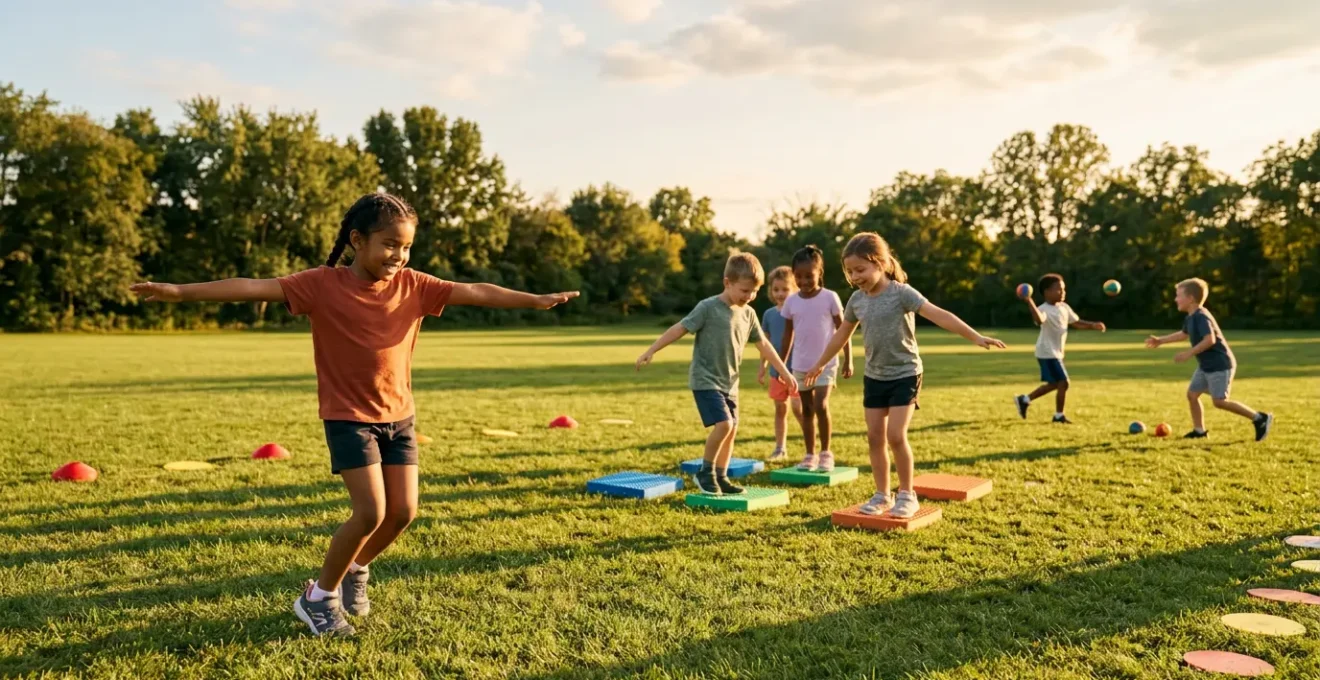
Golf is a low-risk « movement laboratory » that teaches children the foundational mechanics of all rotational sports, making them better, more resilient athletes overall.
- The golf swing isolates and develops core rotational power, a skill directly transferable to throwing, hitting, and kicking.
- Unlike reactive sports, golf teaches self-reliance and the ability to initiate complex movement sequences under pressure, building mental fortitude.
Recommendation: Encourage multi-sport participation with golf as a core « athletic literacy » tool before age 12, focusing on fun, game-based learning over technical perfection.
As a parent, you want your child to be active, coordinated, and confident. But the thought of high-impact contact sports can be daunting. You’re looking for an activity that builds real athletic skills without the high risk of collision injuries. You’ve likely considered soccer, swimming, or gymnastics, but has golf ever crossed your mind? For many, golf is perceived as a slow, technical game for adults—a test of patience more than a display of athleticism. The common wisdom says it teaches etiquette and focus, which is true, but that’s barely scratching the surface.
What if the very thing that makes golf seem different—striking a stationary ball—is its greatest developmental secret? What if this simple act provides the perfect, controlled environment to master the building blocks of all athletic movement? The truth is, golf is a powerful « movement laboratory. » It’s one of the few sports that forces a child to learn how to generate power from the ground up, sequence a complex chain of motion, and rotate their body with explosive force—all skills that form the foundation of what we call « athleticism. » This isn’t about raising the next pro golfer; it’s about developing a child’s fundamental athletic literacy.
This guide will reframe how you see golf. We will explore how the unique challenges of the sport develop a strong core, foster true self-reliance, and teach transferable motor skills. By focusing on play and discovery rather than technical perfection, you can use golf as an unparalleled tool to build a more capable, confident, and physically intelligent child, ready to excel in any physical activity they choose.
In the following sections, we’ll deconstruct the golf swing to reveal its athletic benefits, explore the psychological advantages it offers over team sports, and provide a clear roadmap for introducing the game in a way that fosters long-term development and prevents burnout. Prepare to see golf in a whole new light.
Summary: How Golf Forges a Complete Athlete
- Why Is Striking a Static Ball Harder Than Hitting a Moving One?
- How to Strengthen a Child’s Core Through Natural Swing Mechanics?
- Team Sports or Golf: Which Builds Better Self-Reliance in Kids?
- The Burnout Trap: Why Kids Shouldn’t Play Golf exclusively Before Age 12
- When to Introduce Technical Swing Thoughts to a Junior Golfer?
- How to Use the « Towel Drill » to Sync Arms and Chest?
- Why is Indoor Golf Growing Faster Than Green Grass Participation?
- Why Do Forged Irons Retain Value Better Than Cast Game-Improvement Clubs?
Why Is Striking a Static Ball Harder Than Hitting a Moving One?
It seems paradoxical. A baseball or tennis player must react in a split second to a moving object, while a golfer has all the time in the world to address a stationary ball. Yet, for a developing athlete, hitting the static golf ball cleanly and consistently is an immense challenge. This difficulty is precisely where the developmental magic happens. In reactive sports, the external stimulus (the incoming ball) dictates the timing of the swing. The athlete’s body is responding.
In golf, there is no external cue. The child must internally generate the entire sequence: the decision to start, the tempo of the backswing, the transition, and the explosive release of energy through the ball. This act of self-initiation is a far more complex cognitive and motor task. It forces the development of an internal rhythm and tempo, a skill that is fundamental to all fluid athletic motions. The child isn’t just training their muscles; they’re training their brain to be the conductor of a complex orchestra of movement without a metronome.
Furthermore, this process is a masterclass in focus. The « Quiet Eye » technique, where a player learns to hold a steady gaze on a specific spot on the ball for 2-3 seconds before initiating the swing, has been proven to enhance performance in precision tasks. By learning to strike a static ball, children are not just learning golf; they are learning how to calm their mind, create a pre-performance routine, and execute a complex motor skill under self-imposed pressure—a skill set that is invaluable in sports, academics, and life.
How to Strengthen a Child’s Core Through Natural Swing Mechanics?
Many parents associate core strength with crunches and planks. But the golf swing offers a far more dynamic and functional way to build a powerful « rotational engine » in a child. A proper golf swing is not an arm movement; it’s a full-body rotation that starts from the ground and is driven by the core. Think of the torso as a towel being wrung out—that coiling and uncoiling motion is the source of all power, and it’s one of the most fundamental movements in sports.
This rotational movement, known as the kinematic sequence, teaches a child how to transfer energy efficiently from their larger muscles (legs and torso) to their smaller muscles (arms and hands). This is the exact same principle behind throwing a baseball, hitting a tennis forehand, or kicking a soccer ball. By learning to swing a golf club, a child is instinctively training their body to use this sequence, building strength and stability through their obliques, lower back, and hips in a way that is both safe and highly transferable to other activities.
The beauty of this is that it can be developed through play, not just drills. Instead of focusing on technical positions, parents can encourage games that promote this natural rotational movement. Simple activities like « helicopter spins, » throwing a medicine ball, or even swinging a pool noodle can help a child feel the sensation of their core leading the motion. This builds a strong, stable foundation that not only generates power in the golf swing but also protects the spine and improves balance in all aspects of life. Specialized junior programs recognize this, with many incorporating golf-specific physical therapy to ensure this development is sound.
Team Sports or Golf: Which Builds Better Self-Reliance in Kids?
Team sports like soccer and basketball are lauded for teaching cooperation and collaboration, and rightfully so. They instill a sense of shared purpose and collective responsibility. However, golf teaches a different, arguably more profound, form of personal development: radical self-reliance. On a soccer field, a player can have an off day, but their team might still win. In golf, there is nowhere to hide.
This unique aspect of the sport cultivates an unparalleled sense of accountability. As the experts at the Operation 36 Golf Program explain:
Golf is an individual sport and ‘personal accountability’ is built into the fabric of the game. If you make a high score, it is on you. When you walk off the 18th green, you sign your scorecard and the score that you sign for is what you did.
– Operation 36 Golf Program, 3 Skills That Golf Can Teach Your Child
This immediate feedback loop between action and outcome teaches a child to own their results, both good and bad. A poor shot isn’t the coach’s fault or a teammate’s error; it’s a learning opportunity. This forces a child to develop problem-solving skills on the fly. Should they play a safe shot or a risky one? How do they manage their emotions after a mistake? This constant internal negotiation builds a resilient and resourceful mindset.
Paradoxically, this individual sport is also highly social. While the shots are solitary, the four hours of a round are spent walking and talking with partners. In fact, research shows that communication with others occurs well over 100 times in a typical round of golf. Children learn to interact with peers and adults, follow etiquette, and celebrate others’ successes, all while managing their own internal battle. It’s a powerful combination that builds a self-reliant individual who also knows how to navigate a social world.
The Burnout Trap: Why Kids Shouldn’t Play Golf exclusively Before Age 12
In an era of sports specialization, it’s tempting for parents to find a sport their child enjoys and double down on it, hoping to give them a competitive edge. This is a significant mistake, especially before the age of 12. The data is overwhelmingly clear: early specialization increases the risk of burnout, overuse injuries, and can actually hinder long-term athletic potential. The path to becoming a better athlete is not a narrow one; it’s a wide and varied road.
The goal before puberty should be to build a well-rounded athlete, not just a golfer. Children need to experience a diverse « diet » of movements to develop their full athletic literacy. Playing soccer improves footwork and endurance, gymnastics enhances body awareness and flexibility, and swimming builds total-body strength. Each sport adds another tool to the child’s physical toolbox. In fact, data from the American Development Model shows that an incredible 70% of Olympic Team athletes were multi-sport participants deep into their high school years.
As golf coach Megan Padua states, focusing on broad development pays off. « Letting kids do a bit of everything, playing other sports, developing values in all different areas and not focusing solely on golf helps kids become better athletes, which pays off in the long run. » The rotational skills learned in golf will make a child a better baseball hitter. The balance and ground-force awareness will make them a more powerful soccer player. By encouraging a child to play multiple sports, with golf as one of the key pillars, you are not distracting them from golf; you are building a more robust and adaptable athlete who will be better at golf (and everything else) when they are physically and mentally ready to focus more.
When to Introduce Technical Swing Thoughts to a Junior Golfer?
The short answer: much later than you think. For a young child, the golf course should be a playground for discovery, not a classroom for biomechanics. One of the biggest mistakes parents and coaches make is overloading a junior golfer with internal, technical swing thoughts like « keep your head down, » « straight left arm, » or « shift your weight. » While well-intentioned, this approach stifles a child’s natural ability to learn through feel and exploration.
Research in motor learning consistently shows that an external focus of attention is far more effective for skill acquisition, especially in children. Instead of focusing on body parts (internal), the child should be focused on the task or the target (external). A simple shift in language can make all the difference. « Try to keep your elbow tucked in » is an internal, technical command. « Try to swing so your elbow brushes past your shirt » is an external, relational command. Better still is a purely outcome-based instruction: « Try to make the ball fly over that bunker. »
This approach, often called « discovery learning, » allows a child to self-organize their movements to achieve a goal. They develop their own unique and effective swing based on feel and results, rather than trying to copy a textbook model that may not fit their body. This builds adaptability and problem-solving. By creating fun, task-oriented challenges, you empower the child to become their own best coach. Let them experiment, let them fail, and let them discover what works. The goal is to develop a feel for the club and the ball, not a checklist of mechanical positions.
Action Plan: Fostering Discovery Learning on the Course
- Use Task-Oriented Instructions: Frame everything as a game or challenge. Instead of « Keep your head down, » say, « Try to make the ball fly high like a bird » or « Try to make it roll low like a snake. »
- Create Exploration Challenges: Pose questions that encourage experimentation. « What’s the best way to get the ball to stop near this target? » or « How can you make the ball curve around that tree? »
- Encourage Feel Through Repetition: Let children hit many shots with different clubs to develop a natural feel for how each one affects the ball’s flight, without judgment or technical correction.
- Focus on Target and Outcome: The only thought should be the target. Encourage the child to look at the target, imagine the ball’s flight path, and then simply react. The body is smarter than we give it credit for.
- Allow Unconventional Styles: Especially for children under 8, don’t worry about « correct » grips or stances. As long as they are making contact and having fun, they are building confidence and a love for the game. Refinements can come much later.
How to Use the « Towel Drill » to Sync Arms and Chest?
The « towel drill » is a classic golf instruction tool for a reason. By placing a towel under the armpits, a golfer is forced to keep their arms connected to their torso during the swing. This prevents the arms from becoming disconnected and swinging independently, promoting a more powerful and consistent body-led rotation. The drill teaches a crucial feeling: the arms and chest turning together as a single unit. For developing athletes, mastering this « connection » is a fundamental step in building an efficient kinematic sequence.
However, for a child, the classic towel drill can feel restrictive and boring. The key is to capture the principle of the drill and embed it in a fun, engaging game. A fantastic alternative is the « T-Rex Swing Game. » Have the child cross their arms over their chest, grabbing their opposite shoulders, mimicking a Tyrannosaurus Rex with short arms. From this position, ask them to make « swings » by simply rotating their torso back and through. Because their arms are locked to their body, they have no choice but to use their core to generate the movement.
This game achieves the exact same goal as the towel drill but in a way that feels like play. The child learns to feel their chest, not their hands, leading the swing. You can build on this by having them do « penguin walks » to feel the connection while moving, or adding a light resistance band to enhance the feeling of core engagement. The final step is to transfer that feeling to a real swing, first with a light object like a beanbag, then with a club. By gamifying the drill, you’re teaching one of the most important concepts in the golf swing without the child ever realizing they’re doing a « drill. » They’re just learning to move more efficiently, syncing their body into a powerful, connected unit.
Why is Indoor Golf Growing Faster Than Green Grass Participation?
For decades, the biggest barriers to entry for junior golf were time, cost, and accessibility. A four-hour round is a tough sell for a child with a short attention span. The answer to « is golf boring for kids? » was often, unfortunately, yes. However, the explosive growth of indoor golf simulators and entertainment venues has completely changed this dynamic, especially for youth development. The reason for this growth can be summarized in one word: gamification.
Indoor golf transforms practice from a solitary, repetitive task into an engaging, interactive video game. Children aren’t just hitting balls into a net; they are playing virtual rounds at famous courses, competing in closest-to-the-pin challenges, or trying to hit targets in skill-based games. This environment provides instant, data-rich feedback on every single shot—ball speed, launch angle, distance—all presented in a visually stimulating format. This constant loop of action, feedback, and reward is incredibly compelling for a young mind.
Crucially, this gamified practice isn’t just more fun; it’s more effective. A study on skill-based training revealed that gamified environments lead to 35% greater performance improvement compared to non-gamified training. For precision sports like golf, the gains were even more significant. This demonstrates that when children are engaged and motivated, their rate of learning accelerates dramatically. Indoor golf removes the traditional frustrations of the game (like searching for lost balls) and replaces them with the addictive qualities of a well-designed game, making it an incredibly powerful tool for getting—and keeping—kids excited about the sport.
Key takeaways
- Golf builds the body’s « rotational engine, » a core athletic skill that is directly transferable to sports like baseball, tennis, and soccer.
- To prevent burnout and foster holistic development, children should participate in multiple sports and not specialize in golf before age 12.
- Effective coaching for kids prioritizes fun, game-based learning with an external focus (e.g., « hit the ball to the target ») over internal, technical swing thoughts.
Why Do Forged Irons Retain Value Better Than Cast Game-Improvement Clubs?
In the world of golf equipment, there are two main types of irons. « Cast » irons are made by pouring molten metal into a mold. They are forgiving, easy to hit, and designed to help beginners get the ball in the air. They are a shortcut to decent results. « Forged » irons are crafted from a single piece of soft steel, offering superior feel and feedback but demanding more skill to hit well. This distinction offers a powerful metaphor for teaching athletic skills to children.
Are we, as parents and coaches, providing our children with « cast » or « forged » instruction? The « cast » approach involves giving them shortcuts and equipment-based fixes that mask flaws and produce immediate, but shallow, results. The « forged » approach is about building foundational skills from the ground up, even if it’s more challenging initially. It’s about teaching them to feel and understand their own movement rather than relying on an external aid.
Building a foundational athlete requires the « forged » mindset. It means prioritizing long-term development over short-term wins. It means letting a child struggle and learn from the rich sensory feedback of their mistakes, rather than giving them a quick fix. A child who learns to move well, understand their body, and generate force from their core has a « forged » set of skills that will retain its value and be transferable to any sport they choose for the rest of their life.
The following table illustrates the difference between these two developmental philosophies:
| Foundational Skills (Forged) | Sport-Specific Shortcuts (Cast) |
|---|---|
| Develops proprioception and body awareness | Provides immediate results |
| Transfers to multiple sports | Limited to specific movements |
| Builds adaptable athletes | Creates dependency on aids |
| Long-term athletic development | Short-term performance gains |
| Enhanced ‘feel’ for movement | Reduced sensory feedback |
By embracing golf as a tool for teaching these foundational, « forged » skills, you give your child a gift that extends far beyond any fairway or green. You equip them with a physical intelligence and a resilient mindset that will serve them in whatever athletic endeavors they pursue. Instead of asking « How can my child get good at golf? », the more powerful question is, « How can golf help my child become great at movement? »