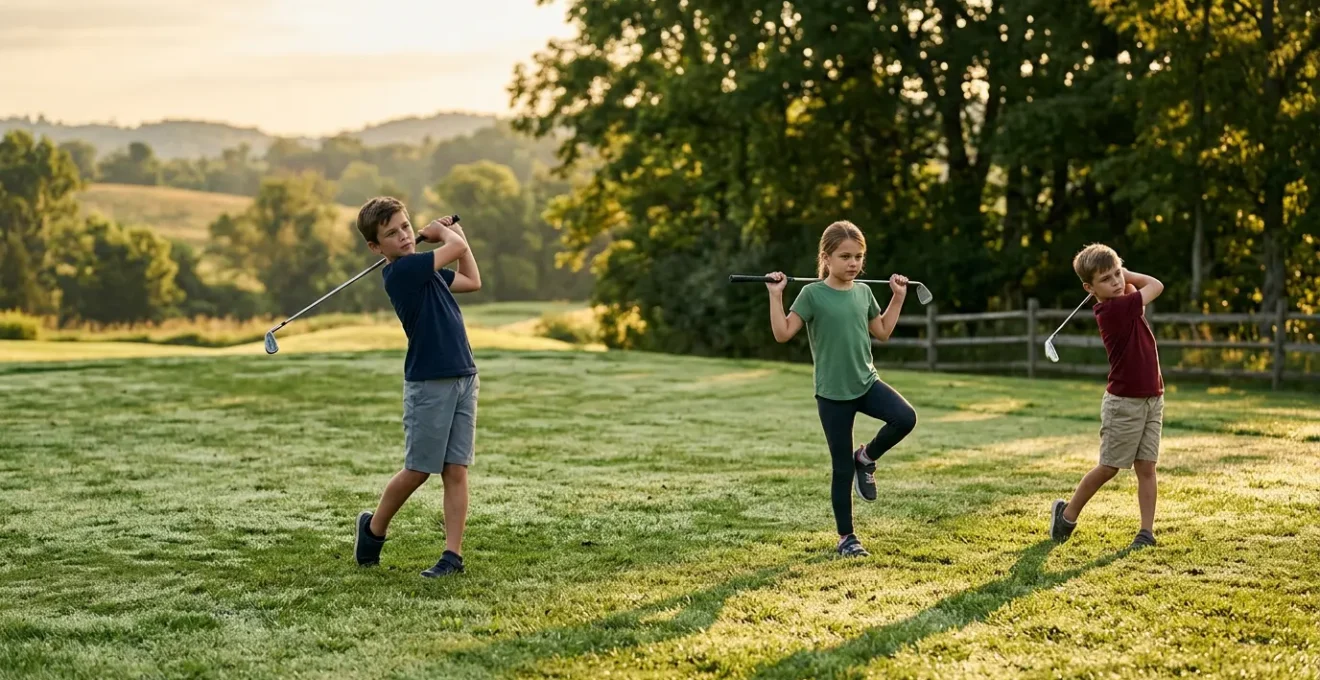
Contrary to popular belief, golf isn’t just a slow-paced game of focus; it’s a powerful athletic development tool that teaches children fundamental movement skills often missed in other sports.
- Striking a stationary ball forces a child to generate a complete kinetic sequence, building coordination from the ground up.
- The golf swing is a dynamic core exercise that develops rotational power and stability, crucial for almost every other athletic activity.
Recommendation: Prioritize play-based golf activities that build a love for movement over early technical instruction to unlock your child’s full athletic potential.
As a parent, finding the right sport for your child can feel like a high-stakes decision. You want an activity that builds confidence, teaches discipline, and, most importantly, helps them develop a healthy, active body. Many parents gravitate toward team sports like soccer or basketball, drawn by their high energy and constant motion. Golf, if considered at all, is often seen as a secondary choice—a quiet game that teaches patience and etiquette, but perhaps lacks the « athletic » component of more dynamic sports.
This common view, however, overlooks a fundamental truth. The core challenge of golf isn’t just about focus; it’s about mastering a complex, full-body movement. What if the real power of golf for a child isn’t in learning to be patient, but in learning how their body moves through space? What if the act of hitting a stationary ball is, paradoxically, one of the best ways to build the foundational skills needed for sports that involve hitting a moving one?
This guide will challenge the conventional wisdom about youth sports. We will explore golf not as a destination sport, but as a foundational movement laboratory. We’ll delve into the biomechanics of the swing to understand how it strengthens a child’s core, how the individual nature of the game builds true self-reliance, and why a play-based approach is critical for long-term athletic development. It’s time to see golf for what it truly is: a unique and powerful tool for building the complete athlete.
This article will provide a comprehensive roadmap for parents. We will break down how the specific demands of golf translate into universal athletic abilities, offering practical insights at every stage of a child’s development. Explore the sections below to understand the science and strategy behind this powerful approach.
Summary: Using Golf as a Foundation for Youth Athleticism
- Why Is Striking a Static Ball Harder Than Hitting a Moving One?
- How to Strengthen a Child’s Core Through Natural Swing Mechanics?
- Team Sports or Golf: Which Builds Better Self-Reliance in Kids?
- The Burnout Trap: Why Kids Shouldn’t Play Golf exclusively Before Age 12
- When to Introduce Technical Swing Thoughts to a Junior Golfer?
- How to Use the « Towel Drill » to Sync Arms and Chest?
- Why is Indoor Golf Growing Faster Than Green Grass Participation?
- Why Do Forged Irons Retain Value Better Than Cast Game-Improvement Clubs?
Why Is Striking a Static Ball Harder Than Hitting a Moving One?
It seems counterintuitive. In sports like tennis or baseball, an athlete must react to a moving object in a fraction of a second. In golf, the ball just sits there, waiting. Yet, for a developing athlete, this stillness is precisely what makes the task so challenging—and so beneficial. When a ball is moving toward a child, their action is partly a reaction. The incoming ball provides external energy and a timing cue. With a static golf ball, the child must be the sole author of the entire sequence. They must initiate, control, and execute a complex motion from a dead start, with no external stimulus to guide them. This requires them to develop a superior sense of proprioception—their body’s internal awareness of its position and movement.
This « closed-skill » nature of golf makes it a pure laboratory for motor skill development. The child isn’t just learning to hit a ball; they are learning to organize their body to create force and transfer it through an object. This process of creating a fluid, powerful motion from scratch builds a deep, intuitive understanding of athletic movement. In fact, the complexities of this task have made it a focal point of sports science, and a 2024 systematic review of 52 controlled trials highlights the extensive research into how these specific motor skills are learned. For a young child, every swing is an experiment in coordinating their body, making golf an exceptional teacher of foundational movement.
How to Strengthen a Child’s Core Through Natural Swing Mechanics?
Many parents associate core strength with crunches or planks. However, the most functional core strength is developed through dynamic, rotational movements—the exact kind of movement at the heart of the golf swing. The swing is not an « arm » motion; it’s a full-body sequence powered by the large muscles of the legs and torso. This sequence is known as the kinetic chain: energy is generated from the ground, transferred up through the legs and hips, amplified by the rotating core, and finally delivered through the arms and club to the ball.
When a child learns to swing a golf club naturally, they are effectively performing a high-repetition, low-impact rotational core exercise. They learn to brace their abdominal muscles to create a stable center while their upper and lower body rotate around it. This process builds strength and stability in the obliques, lower back, and hips. This type of dynamic, rotational strength is the foundation for power in almost every other sport, from throwing a baseball to kicking a soccer ball or changing direction on a basketball court. The golf swing teaches the body’s engine—the core—to power its movements.
As you can see in the motion, a proper swing engages the entire torso. Encouraging a child to « finish in a strong superhero pose » after their swing isn’t just for fun; it teaches them to maintain balance and control through the end of this powerful rotational movement, reinforcing the core stability they are building. Forget sit-ups; a bucket of practice balls is a far more functional core workout.
Team Sports or Golf: Which Builds Better Self-Reliance in Kids?
Team sports are lauded for teaching cooperation and shared responsibility, which are invaluable life skills. However, golf offers a different but equally crucial lesson: radical accountability. In soccer, a missed goal might be blamed on a bad pass. in basketball, a turnover can be lost in the chaos of the game. In golf, there is nowhere to hide. Every shot, good or bad, belongs entirely to the player. This direct and immediate feedback loop is a powerful teacher of self-reliance and emotional regulation.
The Operation 36 Golf Development Program, a leader in youth golf education, captures this unique benefit perfectly. They note that for many children, golf is the first time they must take 100% ownership of their performance. As they state in their parent resources:
Golf is an individual sport and ‘personal accountability’ is built into the fabric of the game. If you make a high score, it is on you. If you hit a poor shot, it is on you. It’s black and white, there is no grey area. When you walk off the 18th green, you sign your scorecard and the score that you sign for is what you did.
– Operation 36 Golf Development Program, 3 Skills That Golf Can Teach Your Child
This environment forces a child to become their own problem-solver. They must analyze what went wrong, manage their frustration without the distraction of teammates, and decide on a strategy for the next shot. This constant cycle of action, result, and analysis builds a level of mental fortitude and independence that is difficult to replicate in a team setting. The table below, adapted from an analysis of youth development benefits, highlights these distinct differences.
| Development Aspect | Golf (Individual) | Team Sports |
|---|---|---|
| Accountability | 100% personal – every shot outcome is the player’s responsibility | Shared responsibility among team members |
| Problem-Solving Opportunities | Constant individual challenges (club selection, shot strategy) | Collaborative problem-solving with teammates |
| Social Interaction Frequency | 100+ verbal/non-verbal communications per round | Variable based on position and sport dynamics |
| Emotional Regulation | Must self-manage frustration with no teammate distraction | Team energy can help regulate individual emotions |
The Burnout Trap: Why Kids Shouldn’t Play Golf exclusively Before Age 12
If golf is such a great athletic developer, it might be tempting to start your child early and have them specialize. This is a significant mistake. The pressure to specialize in a single sport at a young age is one of the biggest contributors to youth sports burnout and overuse injuries. The goal before adolescence is not to create a great golfer; it’s to create a great athlete. This is achieved through a wide variety of physical activities. Children need to run, jump, throw, catch, and swim to develop a broad base of foundational movement skills.
The evidence overwhelmingly supports multi-sport participation. Compelling data from the American Development Model shows that a staggering 70% of U.S. Olympic athletes were multi-sport participants well into their high school years. Forcing a child into one sport too early robs them of the chance to develop the diverse motor patterns that will ultimately make them a better, more resilient athlete. This is especially true during key developmental phases. Youth performance experts point to « windows of opportunity for accelerated adaptation, » particularly for skills like speed, which are best developed through varied activities like sprinting and changing direction quickly. These skills have a strong carryover to golf’s rotational power.
Instead of year-round golf, think of it as one ingredient in a healthy athletic diet. During the spring, your child might play soccer and golf. In the summer, they might swim and play golf. This approach not only prevents mental burnout but also builds a more complete and injury-resistant athlete. Golf’s role is to teach rotational power and coordination, while other sports develop different, complementary skills.
When to Introduce Technical Swing Thoughts to a Junior Golfer?
As a parent watching your child swing, the urge to give technical advice is almost irresistible. « Keep your head down! » « Bend your knees! » While well-intentioned, this kind of explicit instruction can be counterproductive for a young learner. Children, especially under the age of 12, learn movement most effectively through implicit learning—that is, through play, exploration, and goal-oriented tasks, not by consciously thinking about body parts.
When you give a child a technical command, you are forcing them into an « internal focus » (thinking about their body). Research shows that an « external focus » (thinking about the goal) is far more effective for learning motor skills. Instead of « keep your left arm straight, » a better approach is a game-based instruction like, « try to make the ball fly over that bunker » or « let’s see if you can hit this target. » This allows the child’s brain and body to self-organize and figure out the most efficient way to accomplish the task. The movement becomes natural and athletic, not robotic and mechanical.
The best youth coaches are masters of this approach. They use colorful targets, fun games, and modified equipment like pool noodles or beach balls to teach complex movements without a single technical thought. They are building the « feel » of an athletic swing long before they introduce the formal mechanics. Technical thoughts should only be introduced gradually, around age 13 and up, when a child has a solid foundation of athletic feel and can begin to understand cause and effect (e.g., « when my clubface is open, the ball goes to the right »).
How to Use the « Towel Drill » to Sync Arms and Chest?
One of the most common challenges for any golfer, child or adult, is getting the arms and body to work together. Many beginners tend to swing with just their arms, leading to a weak, disconnected motion. The goal is to feel the big muscles of the chest and back powering the swing, with the arms simply along for the ride. This feeling of « connection » is a core principle of athletic movement, and the famous « towel drill » is one of the simplest and most effective ways to teach it.
The drill itself is straightforward: the golfer places a small towel under both armpits and makes swings without letting the towel drop. To keep the towel in place, the arms must stay connected to the torso, forcing the body to rotate as a single, unified unit. This drill provides powerful sensory feedback, making the concept of connection tangible. It replaces a complex technical thought (« sync your turn ») with a simple, intuitive feeling. As one youth coaching resource notes, the movement should feel natural and unhurried, allowing the golfer to feel the mechanics rather than forcing them. This builds the foundation for a proper follow-through, which is an indicator that the swing was executed correctly.
While the towel drill is classic, it’s just one of many ways to teach this crucial feeling of connection without ever using a club. The key is to use drills that promote a sense of unity between the arms and the torso’s rotation.
Action Plan: No-Club Drills for Building Connection
- Hug a Pillow: Have your child hug a pillow or beach ball against their chest. Ask them to rotate back and forth without dropping it to feel their arms and torso moving as one piece.
- Practice the Towel Drill: Use a small towel held under both armpits during slow, deliberate rotation movements to build the primary feeling of connection.
- Medicine Ball Throws: For slightly older kids, practice chest passes and rotational throws with a light medicine ball. This is a perfect demonstration of generating power from the core.
- Skipping Stones: The act of skipping a stone naturally teaches the body to coil and uncoil, using the core to whip the arm through. It’s a perfect, playful analogy for the golf swing’s power source.
- Focus on « Cannon vs. Arm »: Use this simple concept. The torso is the cannon that creates the power; the arms are just the cannonballs that get fired. The cannon has to turn to aim and fire.
Why is Indoor Golf Growing Faster Than Green Grass Participation?
For decades, golf was synonymous with quiet, manicured courses and a significant time commitment. This created a high barrier to entry, especially for busy families. However, a technological revolution is changing the face of the sport. The rise of modern, accessible, and entertaining indoor golf simulators is fueling a massive surge in participation, particularly among juniors. This « off-course » version of golf removes many of the traditional obstacles: it’s not weather-dependent, a session can last an hour instead of five, and the game-like environment is far less intimidating for a beginner.
The numbers are staggering. According to a recent report, the global golf simulator market is projected to grow from $1.92 billion in 2025 to over $4.7 billion by 2034. This growth is driven by a massive influx of new, younger players. Data highlighted by the golf analysis newsletter Perfect Putt shows that between 2019 and 2023, off-course junior golf participation skyrocketed by 82%, from 2.2 million to 4 million kids. Today, juniors make up over a quarter of all off-course participants.
For parents, this trend is a game-changer. Indoor golf centers provide a perfect « on-ramp » to the sport. They offer a controlled environment where kids can learn the fundamental motion of the swing in a fun, low-pressure setting. Many simulators have modes specifically designed for children, turning practice into an engaging video game. This allows kids to fall in love with the feeling of striking a ball and seeing it fly—the core joy of the game—without the complexities of course management or etiquette. It’s a perfect first step in building athletic skills before ever setting foot on a real fairway.
Key Takeaways
- Golf’s core challenge—hitting a stationary ball—is a superior tool for teaching coordination and the kinetic chain from the ground up.
- Early specialization in any single sport, including golf, is a leading cause of burnout and injury; prioritize multi-sport participation before age 12.
- Children learn movement best through play and external goals (« implicit learning »), not through direct technical instruction (« explicit learning »).
Why Do Forged Irons Retain Value Better Than Cast Game-Improvement Clubs?
This question seems highly technical, but the principle behind it is crucial for a parent choosing equipment for a young athlete. « Game-improvement » clubs, which are typically ‘cast,’ are designed with large, forgiving heads that help minimize the effect of a bad swing. « Forged » irons, traditionally preferred by better players, are made from a softer metal and provide much more direct, unfiltered feedback on where the ball was struck. While they retain value for different market reasons, the key lesson for junior development is about feedback vs. compensation.
Giving a beginner the most forgiving club available is like giving a student a calculator before they’ve learned basic math. It provides the right answer without teaching the process. A club that masks mishits robs the child of the most important piece of information they need to learn: the feeling of a pure strike versus an off-center one. This sensory feedback is the language of motor skill development. The child needs to feel the difference between a good swing and a bad one to be able to self-correct and improve.
This doesn’t mean you need to buy expensive forged irons for your 8-year-old. The principle is what matters. When selecting equipment, the goal should be to find clubs that are properly fitted for your child’s size and strength, but that do not overly compensate for poor technique. Simple, basic clubs are often better teachers than high-tech, ultra-forgiving ones. The focus should always be on building a sound, athletic motion first. The equipment is there to support that motion, not to create a shortcut around it. Ultimately, the best tool is one that challenges the child to improve, not one that makes them feel good about their mistakes.
The next logical step is to find a program that focuses on fun and foundational movement. Look for coaches who use games and multi-sport activities, not just technical drills, to introduce your child to the athletic joy of golf. By prioritizing a well-rounded athletic base, you are giving them the tools to succeed not just in golf, but in any physical activity they choose to pursue.