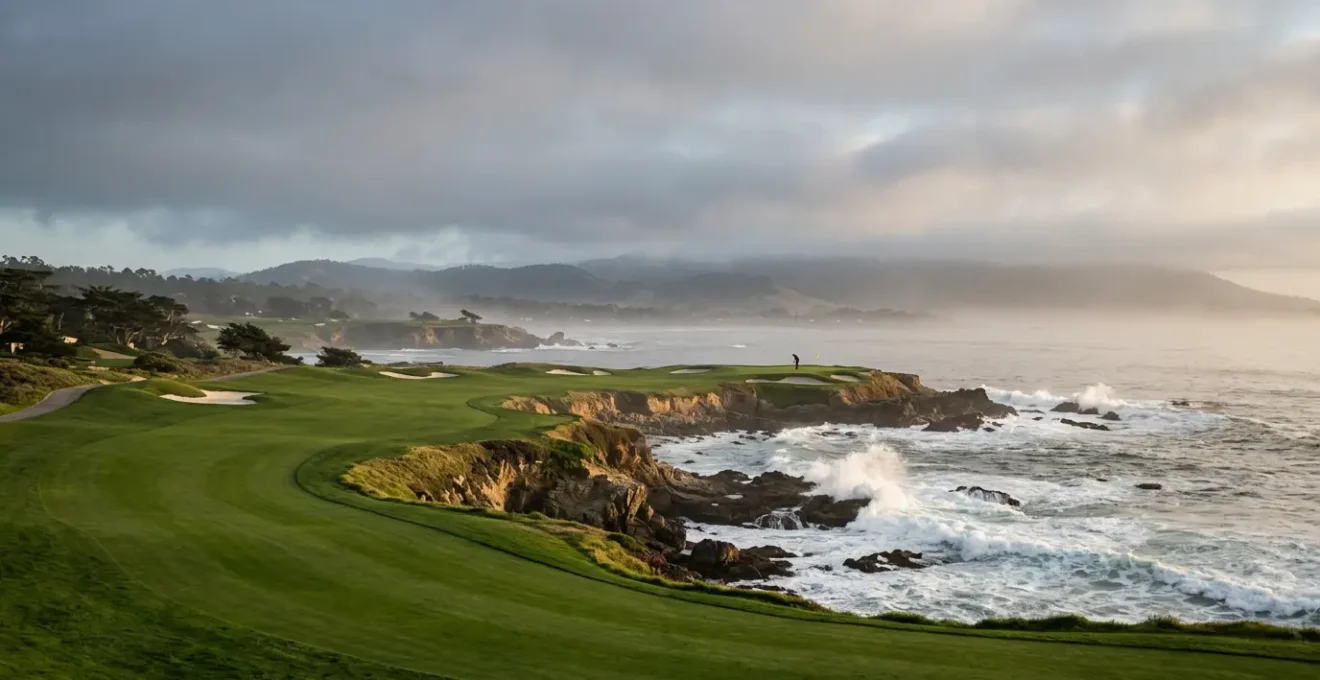
The staggering green fee at Pebble Beach is justified, but only if viewed as an investment in a complex portfolio of tangible assets and intangible experiences, rather than a simple round of golf.
- The cost reflects ongoing battles against nature, like coastal erosion, and the operational excellence required to maintain major championship conditions daily.
- The true value is unlocked by understanding and strategically navigating unique variables, such as the « Marine Layer Tax » on ball flight and the mental challenge of a six-hour round.
Recommendation: To realize the full return on this investment, a golfer must prepare not just their swing, but their mindset, treating the round as an immersive, strategic event.
For any serious golfer, the question looms large: is playing Pebble Beach truly worth the $600+ green fee? It’s a figure that places the experience firmly in the realm of luxury travel, inviting scrutiny beyond mere course rankings. The common justifications—that it’s a « bucket list » round with « unforgettable views »—are emotionally true but analytically shallow. They fail to address the core of the debate for a discerning player weighing a significant financial commitment. To simply say it’s famous because it’s famous is a circular argument that sidesteps the real conversation about value.
A proper analysis requires a shift in perspective. Instead of viewing the green fee as a high price, we must audit it as a complex investment. What tangible and intangible assets are you actually acquiring for the day? The value proposition of Pebble Beach is not just in playing the 18 holes; it’s in experiencing a meticulously engineered product, a living museum of golf history, and a unique confrontation with nature. The true return on investment is found in understanding the immense operational pressures, from coastal erosion to specific agronomic standards, that make each round possible at this level.
This analysis will deconstruct the Pebble Beach experience through the lens of a value analyst. We will move beyond the postcards to examine the specific environmental challenges, the strategic nuances of the course’s unique atmosphere, and the mental frameworks required to extract maximum value from the day. The goal is to determine not just *if* it’s worth the money, but *how* a golfer can ensure they receive the full, multi-faceted return on their investment in this once-in-a-lifetime round.
This article provides a detailed breakdown of the value proposition behind a round at Pebble Beach. We will explore the hidden costs of its preservation, the strategic decisions you’ll face before and during your round, and how to turn potential drawbacks into unique advantages.
Summary: Deconstructing the Value of a Pebble Beach Round
- Why Does Coastal Erosion Threaten the Future of the 18th Hole?
- How to Navigate the Resort Stay-to-Play Requirement for Tee Times?
- Pebble Beach or Spyglass Hill: Which is the Better Test of Golf?
- The Weather Mistake: Assuming Sunshine in July on the Monterey Peninsula
- Why Does the Ball Fly 10% Shorter at Sea Level in the Morning?
- How to Adjust Your Club Selection for Heavy Pacific Air?
- Ocean Waves or Forest Silence: Which Soundscape Promotes Better Rhythm?
- How to Handle a 6-Hour Round Without Losing Your Rhythm?
Why Does Coastal Erosion Threaten the Future of the 18th Hole?
A significant, often invisible, component of your green fee is an investment in preservation. Pebble Beach is not a static landscape; it is a property in a constant, high-stakes battle with the Pacific Ocean. The iconic 18th hole, a curving par-5 along Stillwater Cove, exists on a knife’s edge. Coastal erosion is an active and relentless threat that requires immense, ongoing capital expenditure to mitigate. This isn’t just about maintaining aesthetics; it’s about physically preventing one of golf’s most famous finishing holes from disappearing into the sea.
The Pebble Beach Company’s commitment to protecting this asset is a core part of its operational identity. As Executive Vice President Mark Stillwell stated, « The Pebble Beach Golf Links course is ranked the number one public golf course in the nation. It’s a tremendous asset to the area and our company. It needs to be protected. » This protection is a complex and costly endeavor, involving environmental studies, engineering projects, and navigating regulatory bodies.
For example, emergency repairs have involved installing temporary seawalls to shield the green. These interventions are not permanent solutions. According to California Coastal Commission documents, the construction of proposed permanent seawalls would come at a significant environmental cost, resulting in an estimated 6,456 cubic yards of sand loss over a 20-year period. Your green fee, therefore, is not just for pristine fairways; it’s a contribution to the complex, costly, and continuous effort to preserve the very ground on which you play.
How to Navigate the Resort Stay-to-Play Requirement for Tee Times?
For the public golfer, access to Pebble Beach is intrinsically linked to the resort. The stay-and-play requirement—mandating a multi-night stay at a Pebble Beach Resorts property to secure an advanced tee time—is often seen as the biggest financial hurdle. From a value analyst’s perspective, this should not be viewed as an ancillary cost but as part of the total investment package. The key is to shift from seeing it as an obligation to an opportunity, actively leveraging the resort’s amenities to maximize the return on your expenditure.
The mandatory stay is a mechanism for quality control, ensuring a certain level of service and experience across the board. The challenge for the golfer is to extract every ounce of value from it. This means planning your non-Pebble Beach hours with the same strategic intent as you plan your round. The resort offers a suite of exclusive « experience assets » that are included or easily accessible as a guest.
To truly maximize your investment, consider a tactical approach to your stay:
- Book an early morning practice round at The Hay, the short course designed by Tiger Woods, to warm up before your main tee time.
- Experience the 17-Mile Drive at sunrise, offering unparalleled photo opportunities without the usual crowds.
- Reserve caddie services well in advance; their local knowledge can be worth several strokes, a direct return on investment.
- Access the Pebble Beach Golf Academy’s TrackMan technology for a pre-round club fitting or a data-driven practice session.
- Schedule post-round recovery treatments at the luxurious Spa at Casa Palmero.
By treating the resort stay as an integral part of the experience to be exploited, rather than an additional fee, you transform a significant cost into a significant value-add.
Pebble Beach or Spyglass Hill: Which is the Better Test of Golf?
Within the Pebble Beach portfolio, Spyglass Hill often enters the conversation as a brutish, highly-ranked alternative. For the value analyst, the comparison is crucial: is Pebble Beach’s superior price tag justified by a superior test of golf? The data suggests they are tests of different things. Spyglass Hill is arguably a purer, more relentless examination of ball-striking, while Pebble Beach is a test of nerve, adaptability, and one’s ability to perform on the grandest stage in golf.
This paragraph introduces a concept complex. To well the understand, it is useful to visualize his main components. The illustration below breaks down this process.
As the image of the iconic 7th hole shows, the value of Pebble is tied to its memorability and historical weight. You are paying for the privilege of walking in the footsteps of giants and facing shots etched into golf lore. Spyglass provides an incredible challenge, but Pebble provides a legacy.
A direct comparison of their championship metrics reveals the difference in their value proposition. This is not about which course is « better, » but which one delivers the unique assets that command the premium price.
| Metric | Pebble Beach | Spyglass Hill |
|---|---|---|
| Major Championships Hosted | 7 (6 U.S. Opens, 1 PGA) | 0 |
| Public Course Ranking | #1 in America since 2003 | Top 50 |
| Historical Significance Score | 10/10 (Watson chip-in, Nicklaus 1-iron) | 6/10 |
| Ocean Holes | 8 holes along Pacific | 5 holes with ocean views |
| Memorability Factor | Iconic 7th and 18th holes | Forest/links combination |
The table makes the distinction clear. While Spyglass is an elite course, Pebble Beach’s value is compounded by its unrivaled history and iconic status. You are paying a premium for a championship pedigree and a walk through a living museum, assets that Spyglass, for all its strengths, cannot offer at the same level.
The Weather Mistake: Assuming Sunshine in July on the Monterey Peninsula
One of the most common and costly mistakes a visitor can make is equating « California » with « sunshine, » especially during the summer. The Monterey Peninsula is governed by a unique microclimate dominated by the marine layer—a dense, cool, and humid blanket of fog that rolls in from the Pacific. Assuming a warm, sunny day is a recipe for disappointment and poor play. Understanding and embracing this atmospheric phenomenon is a key part of the Pebble Beach experience; it’s a strategic variable you must account for.
This is what physicists call the ‘Marine Layer Tax’—a tangible effect on performance. The cool, heavy air is not just a feeling; it has a measurable impact on how the golf ball flies. Research in sports physics provides a clear framework for this. The « Marine Layer Effect on Ball Flight » study clarifies the complex interplay of atmospheric conditions. While increased humidity can slightly increase carry distance, this is more than negated by the drop in temperature.
As physicist Alan Nathan notes in his research, the effect is quantifiable. He explains, « A 10-degree decrease in temperature will shorten the distance of a fly ball by about three feet, while a 50 percent increase in relative humidity will increase the distance by roughly one foot. » The net result of the cool, humid fog is a noticeable loss of distance, particularly for rounds played in the morning before the sun has a chance to burn through the layer.
Appreciating this is crucial for a value-oriented mindset. You are not paying for a guaranteed sunny day. You are paying for a unique, strategic challenge presented by one of golf’s most famous and fickle microclimates. Showing up with the right gear and, more importantly, the right expectations, is essential to enjoying the round. The marine layer isn’t a flaw in the experience; it *is* the experience.
Why Does the Ball Fly 10% Shorter at Sea Level in the Morning?
The « Marine Layer Tax » discussed previously isn’t just a qualitative feeling; it’s a quantifiable reality that directly impacts club selection. The combination of Pebble Beach’s sea-level elevation and the typical cool, dense morning air creates a perfect storm for reduced ball flight. For golfers accustomed to playing at higher elevations or in warmer, drier conditions, the difference can be jarring, often resulting in a loss of up to 10% on carry distance.
This distance loss is a product of two primary factors: air density and temperature. At sea level, the air is inherently denser than at altitude, creating more drag on the golf ball. When you compound this with the cool temperatures of a classic Monterey morning (often in the 50s°F / 10-15°C), the air becomes even denser, further inhibiting ball flight. Golf physics analysis confirms this compound effect: a player’s standard 250-yard drive can easily become a 225-yard shot in these conditions.
This is not just theory; it is a practical reality confirmed by top instructors. Mike Morrone, Head Golf Professional at the Foundry Golf Club, explains the temperature component simply. « Studies have shown it’s about two yards for every ten degrees, » he says. « So, if you hit a drive that’s 250 yards on a 70° day… it will go four yards shorter on a day that’s 50°. » When you factor in the additional effects of air density and morning moisture on the clubface reducing spin, the ‘Marine Layer Handicap’ can feel like it effectively adds two strokes to your playing handicap before you even start.
Understanding this 10% reduction rule is a non-negotiable part of preparing for Pebble Beach. It transforms club selection from a simple matter of yardage to a complex calculation involving time of day, temperature, and feel. This is part of the strategic depth you are paying for.
How to Adjust Your Club Selection for Heavy Pacific Air?
Knowing that the heavy Pacific air will cost you distance is one thing; knowing how to strategically adjust is another. Successfully navigating Pebble Beach requires a dynamic approach to club selection that goes far beyond the numbers on a sprinkler head. It demands that you trust your observations and your caddie over your ego and your standard yardages. The key is to have a clear, pre-defined adjustment strategy.
The most straightforward rule is to club up. In heavy morning marine layer conditions, taking at least one extra club is standard procedure. This simple adjustment accounts for the baseline 10% distance loss. However, a more refined strategy involves layering multiple factors to arrive at the correct club choice. The conditions at Pebble are rarely singular; you’re often facing a combination of cool air, humidity, sea-level pressure, and wind.
The following table provides a clear framework for these adjustments. It breaks down each atmospheric condition and its typical impact, allowing you to build a comprehensive club selection formula.
| Condition | Distance Effect | Club Adjustment |
|---|---|---|
| Marine Layer (morning) | -10% carry | +1 full club |
| Cold temperature (50°F vs 70°F) | -4 yards per 100 | +0.5 club |
| High humidity (90%) | +1 yard per 150 | No change |
| Sea level pressure | -5% vs elevation | +0.5 club |
| Wet conditions | -5-10 yards | +1 club |
To put this into practice, developing a course-specific gapping strategy is the ultimate value-add. This means going beyond simple adjustments and building a new set of expectations for your game on that day. A practical gapping plan includes creating a morning-specific yardage chart, potentially using lower-compression golf balls that perform more efficiently in the cold, and prioritizing lower-trajectory shots that bore through the heavy air. Above all, it means trusting the local knowledge of your caddie, who makes these intricate calculations on a daily basis.
Ocean Waves or Forest Silence: Which Soundscape Promotes Better Rhythm?
A significant, though often subconscious, part of the Pebble Beach value proposition is its unique sensory experience. The eight holes running along the Pacific are not just visually spectacular; they are aurally distinct. This is a critical point of contrast with its sibling course, Spyglass Hill, which quickly dives into the quiet solitude of the Del Monte Forest. From a performance perspective, the soundscape is not just background noise; it’s a tool that can either help or hinder your rhythm and focus.
This paragraph introduces a concept complex. To well the understand, it is useful to visualize his main components. The illustration below breaks down this process.
The auditory environment of Pebble Beach is dominated by the rhythmic, constant crashing of Pacific waves. Psychoacoustic research suggests this is a powerful performance aid. The sound of ocean waves approximates what is known as ‘pink noise’—a low-frequency, constant sound that is highly effective at masking distracting, intermittent noises like a distant car or a fellow golfer’s cough. This consistent sonic blanket can promote a state of focus and calm.
Furthermore, the rhythm of the waves themselves, typically around 12-15 per minute, can act as a natural metronome. Golfers can subconsciously sync their pre-shot routine to this steady, environmental rhythm, promoting a consistent tempo. In contrast, the deep silence of the Spyglass Hill forest can be more jarring. While peaceful, the quiet is punctuated by sudden, sharp sounds—a snapping twig, a bird call—that can break concentration more easily than the constant hum of the ocean. This « Sensory ROI » is a subtle but real asset, where the environment itself contributes to a better playing experience.
Key Takeaways
- The green fee is an investment in preservation, history, and a unique set of strategic challenges.
- Maximize value by leveraging the mandatory resort stay and its exclusive amenities.
- Embrace the « Marine Layer Tax » by adjusting club selection (+1 club minimum) and playing lower-trajectory shots.
- Reframe the slow pace of play as an opportunity for mental rehearsal and appreciating the surroundings.
How to Handle a 6-Hour Round Without Losing Your Rhythm?
Let’s address the elephant on the fairway: the pace of play. A round at Pebble Beach can, and often does, stretch to six hours. For many golfers, this would be a deal-breaker, a frustrating slog that destroys any sense of rhythm. However, from a value analysis standpoint, this must be anticipated and reframed. The slow pace is a feature, not a bug. It’s a byproduct of the course’s popularity, its difficulty, and the sheer number of golfers pausing to capture the moment. Your mission is to turn this « downtime » from a liability into an asset.
Losing your rhythm during long waits is a real danger. The key is to replace frustration with a structured mental routine. Instead of passively waiting, you should actively engage your mind. This is where you can lean on another one of the course’s premier assets: your caddie. As the course management philosophy states, « The best walk in golf is meant to be that — walked. The course knowledge and camaraderie our caddies provide only add to your bucket-list round. » Use the waits to tap into this knowledge, asking about course history, strategy for the upcoming holes, or tales of celebrity rounds.
This transforms a boring wait into a valuable information-gathering session. By preparing a mental reset routine, you can maintain focus and ensure the pace of play doesn’t derail your performance or your enjoyment. The goal is to control your internal clock when the external one is moving slowly.
Your Action Plan: The Mental Reset Routine for Extended Rounds
- Tee Box Photography: While waiting, frame one perfect, artistic photograph of the hole. This focuses your eye on the landscape’s beauty rather than the delay.
- Caddie Engagement: Engage your caddie for course history stories. They have decades of celebrity tales and strategic insights that are part of the experience you paid for.
- Nicklaus Visualization: Use the extra time to mentally play the upcoming shot from multiple angles and with different shot shapes, just as Jack Nicklaus famously did.
- 3-3-3 Breathing: Implement a simple breathing pattern between shots (inhale for 3 seconds, hold for 3, exhale for 3) to maintain a calm physiological state and sharp focus.
- Gratitude Checkpoint: At each ocean-view hole, take a moment to consciously acknowledge where you are. This simple act of gratitude resets your perspective and combats frustration.
By adopting these techniques, you are not just « coping » with a six-hour round; you are leveraging it. You are using the extra time to deepen your appreciation, sharpen your strategy, and maintain peak mental condition. This is how you ensure maximum return on every minute of your investment.