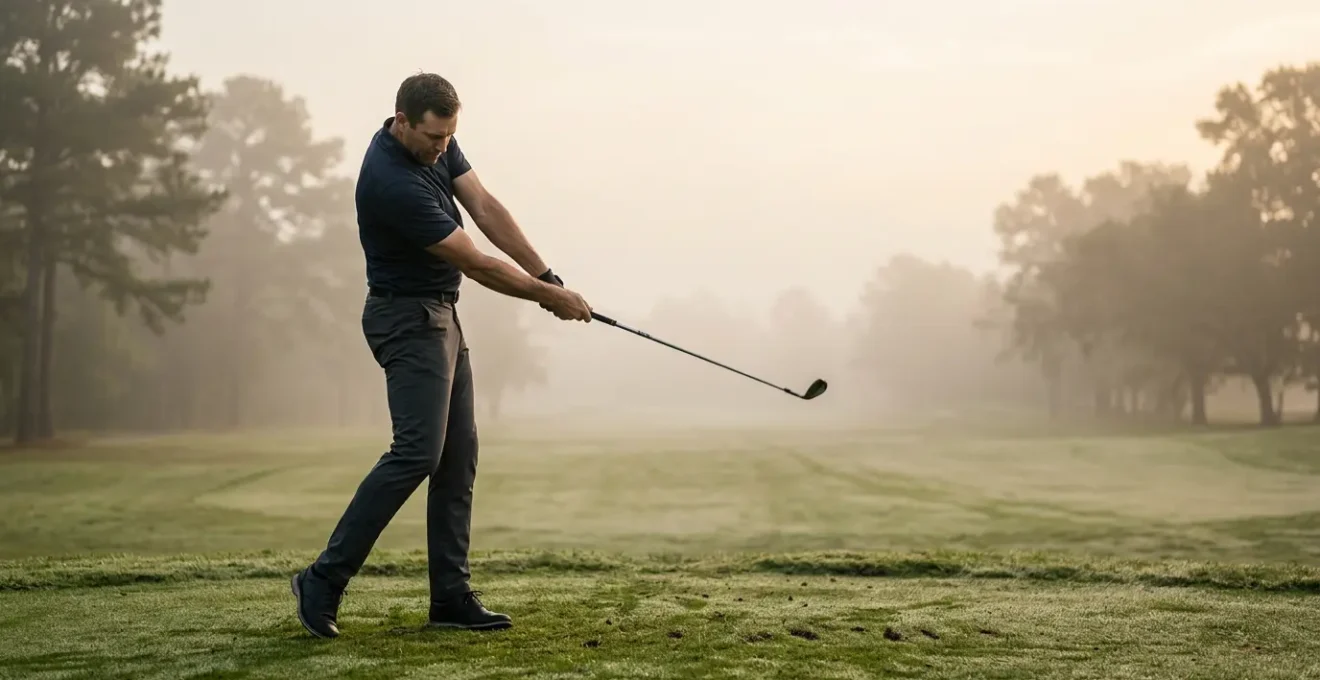
For the aging athlete, the choice isn’t between competition and joint preservation; it’s about finding the *right* competition.
- Golf is safer not because it’s ‘low-impact,’ but because its manageable rotational forces are fundamentally different from the repetitive, high-impact vertical loads of running.
- Targeted modifications in swing mechanics, equipment choices, and recovery protocols can dramatically mitigate the specific stresses golf places on the knees, back, and elbows.
Recommendation: By adopting a biomechanically-aware approach, golf can be a sustainable, competitive, and joint-friendly sport for a lifetime.
As a sports medicine physician, I frequently consult with athletes facing a difficult crossroads. After years of high-impact sports like running or tennis, their knees, hips, and back begin to protest. The competitive fire still burns, but the fear of chronic pain and further joint degradation looms large. The common advice is to switch to a « low-impact » activity, and golf is invariably at the top of that list. While this advice is well-intentioned, it’s dangerously incomplete. It perpetuates the myth that golf is a gentle stroll, ignoring the complex and powerful forces it generates.
The truth is, golf is not a universally « safe » sport; it is a *strategically* safer sport for those with joint concerns, but only when understood and approached correctly. The key isn’t simply avoiding the high-frequency impacts of running. It is about understanding, managing, and mitigating a completely different set of biomechanical loads—specifically, rotational and shear forces. A poorly executed golf swing can be just as damaging as a 10k run on pavement, albeit to different structures and in different ways. The goal of this guide is to move beyond the platitudes and provide a medical, evidence-based framework for making golf a sustainable and rewarding athletic pursuit.
We will deconstruct the unique stresses of the golf swing, compare them to other activities, and provide concrete strategies for playing safely with pre-existing conditions. From swing mechanics for a torn meniscus to equipment choices that dampen vibration, you will gain the understanding needed to protect your joints while staying in the game.
Summary: A Physician’s Analysis of Joint-Safe Golf
- Why Does Golf Stress the Lead Knee Differently Than Running?
- How to Swing with a Torn Meniscus Without Further Damage?
- Swimming or Golf: Which Is Better for Active Recovery Days?
- The « Weekend Warrior » Mistake That Leads to Achilles Tendonitis
- When to Stop Playing to Prevent « Golfer’s Elbow » from Becoming Chronic?
- Graphite or Steel: Which Shaft Material Reduces Elbow Vibration?
- How to Swing Safely with Lower Back Pain Issues?
- How to Optimize Your Circadian Rhythm for a 7 AM Tee Time?
Why Does Golf Stress the Lead Knee Differently Than Running?
The primary difference between the stress golf and running place on the knees lies in the direction of the force. Running is characterized by repetitive, vertical ground reaction forces that compress the knee joint with every foot strike. Golf, in contrast, generates immense rotational and shear forces during the swing. While often labeled « low-impact, » the peak compressive force on the lead knee during a golf swing can be significant. In fact, research demonstrates that knee compression can reach up to 329% of body weight, a force comparable to some phases of running.
However, the danger isn’t in the magnitude of the force alone, but in its nature. A 2022 study in Scientific Reports provides critical insight. The researchers found that the key stressor in golf is the « peak knee adduction moment »—a rotational twisting force on the lead leg around the point of impact. This is fundamentally different from the straight-line, up-and-down compression of running. This rotational load is what can aggravate meniscal tears or place strain on ligaments if not managed properly through technique and conditioning.
As the illustration highlights, the lead knee acts as a stable post around which the body’s momentum pivots. A proper swing, with good hip rotation and core engagement, allows this force to be distributed through the large muscles of the legs and glutes. A poor swing, however, where the hips are « stuck » or weight transfer is inefficient, forces the knee joint itself to absorb this powerful rotational shear. Therefore, the goal for a joint-conscious golfer is not to eliminate force, but to ensure it is channeled correctly through the kinetic chain, rather than being concentrated as a damaging twist on the knee.
How to Swing with a Torn Meniscus Without Further Damage?
Playing golf with a meniscal injury requires a strategic shift in your swing mechanics, moving from a power-first to a preservation-first mindset. The meniscus is a C-shaped piece of cartilage that acts as a shock absorber between your shinbone and thighbone. A tear makes it vulnerable to the rotational and compressive forces we discussed. The primary goal is to reduce tibial rotation relative to the femur and minimize deep knee flexion, both of which stress the injured tissue.
From a clinical perspective, several modifications are essential. First, adopt a slightly more ‘open’ stance at address, with your lead foot flared out about 20-30 degrees. This pre-rotates the tibia, reducing the amount of internal rotation required during the downswing and follow-through. Second, shorten your backswing. A full, deep backswing can cause excessive rotation and compression on the lead knee as you load into it. A three-quarter backswing can significantly reduce these forces while still generating ample clubhead speed through better sequencing.
Furthermore, focus on a « quieter » lower body. Amateurs often try to generate power by aggressively sliding or spinning their hips. With a meniscal tear, you must learn to generate power from the ground up through your core and thoracic spine rotation. Think of your lower body as a stable base, not the primary engine. Finally, finish your swing in a balanced, upright position. A « classic » reverse-C finish puts enormous stress on both the back and the lead knee. Instead, aim for a more modern, upright finish where your weight is fully posted on your lead leg with the knee softly flexed, not hyperextended or twisted.
Swimming or Golf: Which Is Better for Active Recovery Days?
Athletes often confuse a less intense sport with a true recovery activity. While a leisurely round of golf is certainly less taxing than a tennis match, it is not an optimal tool for active recovery from a physiological standpoint. Golf, even when walking, involves concentric and eccentric muscle contractions, significant spinal rotation, and sustained focus. It is a sport, not a restorative therapy. For genuine active recovery, swimming is clinically superior.
The benefits of swimming for recovery are multi-faceted. The hydrostatic pressure of the water provides gentle compression to the entire body, which can help reduce swelling and improve circulation to flush out metabolic byproducts like lactic acid. The buoyancy of water unloads the joints completely, allowing for full range of motion without the compressive stresses of gravity. This is invaluable for an athlete with sore knees or a stiff back. The horizontal body position in swimming also gives the cardiovascular system a different challenge, promoting blood flow without the postural demands of standing and walking for four hours.
The effectiveness of swimming isn’t just theoretical. An influential study on elite triathletes published in the International Journal of Sports Medicine provides clear evidence. After an intense running session, athletes who used swimming as their recovery method showed a subsequent 14% improvement in their next run to fatigue and had lower levels of C-reactive protein, a key biomarker for inflammation. Golf cannot offer these specific restorative benefits. Therefore, the roles should be clear: golf is your sport, your competitive outlet. Swimming is your tool to help your body recover from that sport, ensuring you can play again sooner and with less pain.
The « Weekend Warrior » Mistake That Leads to Achilles Tendonitis
One of the most common injury patterns I see in amateur golfers is the « weekend warrior » syndrome. This describes the athlete who is sedentary most of the week and then engages in intense activity—like playing 36 holes and hitting 200 range balls—over a two-day period. This boom-and-bust cycle is a primary driver of overuse injuries, particularly Achilles tendonitis. The Achilles tendon connects your calf muscles to your heel bone and is crucial for walking, especially on the uneven terrain of a golf course. It is a tissue that thrives on consistency and progressively increased load, not sudden shocks.
When you walk a golf course, you’re taking thousands of steps, often on hills and side-slopes, placing continuous eccentric load on the Achilles. If your tendon is not conditioned for this volume, micro-tears and inflammation can accumulate, leading to the pain and stiffness of tendonitis. The issue is compounded by improper footwear and, most critically, the absence of a proper warm-up. This reality is reflected in injury statistics; studies show that up to 50% of amateur golfers report an orthopedically related injury, many of which are preventable overuse conditions.
The single biggest mistake is going from « zero to sixty. » A simple five-minute dynamic warm-up focusing on ankle circles, calf raises, and light leg swings can dramatically improve blood flow to the tendon and prepare it for the demands of the round. As Physical Therapist Zaparinuk notes, « Warm-up is extremely important in any sport to prevent and decrease injuries. » A post-round routine of gentle calf stretching is equally vital to help the tendon recover and maintain its flexibility. The solution is not to play less, but to prepare more. Integrating even 10-15 minutes of daily calf strengthening and stretching throughout the week provides the « tissue insurance » needed to handle the demands of a weekend round without breakdown.
When to Stop Playing to Prevent « Golfer’s Elbow » from Becoming Chronic?
Golfer’s elbow, or medial epicondylitis, is an inflammation of the tendons that connect your forearm muscles to the inside of your elbow. It’s a classic overuse injury, often caused by an improper grip, a faulty swing mechanic (like « casting » the club), or simply hitting too many balls off hard mats. The most critical error an athlete can make with this condition is attempting to « play through » the pain. This approach can turn an acute, easily managed issue into a chronic, debilitating problem. The difference in outcome is stark; clinical data reveals that with early intervention and rest, recovery can take as little as 3 weeks, whereas ignoring the symptoms can lead to a recovery process lasting 9 months or more.
The key is to recognize the earliest warning signals before the pain becomes constant. Mild discomfort that appears after a round but is gone by the next morning is the first sign. If you ignore this and continue to stress the tendon, you’ll progress to morning stiffness and pain during non-golfing activities, like shaking hands or opening a jar. This indicates the inflammation is becoming persistent. At this stage, immediate rest is no longer optional—it is mandatory to prevent long-term tissue damage.
Listening to your body requires a more structured approach than simply waiting for sharp pain. By systematically monitoring for subtle signs, you can intervene early, take a short break, address the root cause (e.g., get a lesson, change your equipment), and return to the game quickly. Ignoring these signs is a gamble with your long-term ability to play.
Action Plan: Early Warning Signs Checklist for Chronic Golfer’s Elbow
- Monitor Grip Strength: Notice any new difficulty opening jars, turning a doorknob, or performing everyday gripping tasks? This indicates early tendon stress accumulation.
- Assess Morning Stiffness: Is there stiffness in your elbow upon waking that requires more than 10 minutes of movement to resolve? This suggests inflammation is building overnight.
- Track Post-Round Pain Patterns: Is a dull, persistent ache appearing 2-6 hours after you finish playing, rather than during the round itself? This delayed onset is a critical early warning signal of tissue overload.
- Perform the Resisted Wrist Flexion Test: Extend your affected arm, palm up. Use your other hand to gently press down on your fingers as you try to curl your wrist upward. Sharp, localized pain at the bony bump on the inside of your elbow is a positive test and requires immediate rest.
- Calculate Your Weekly ‘Tendon Stress Budget’: Track your cumulative exposure (number of practice balls + holes played). If you exceed your typical weekly volume by more than 30%, you are significantly increasing your risk of chronic injury.
Graphite or Steel: Which Shaft Material Reduces Elbow Vibration?
For a golfer concerned with joint health, particularly golfer’s or tennis elbow, the choice of shaft material is not a minor detail—it’s a critical component of your injury prevention strategy. The impact between the clubface and the golf ball creates a high-frequency vibration that travels up the shaft and into your hands, wrists, and elbows. The material of the shaft plays a significant role in either dampening or transmitting these harmful vibrations. For reducing vibration, graphite is unequivocally superior to steel.
Steel shafts are prized by many competitive players for the crisp, detailed sensory feedback they provide on strike quality. However, this high fidelity comes at a cost: they transmit nearly all shock and vibration directly to the player’s body. For a joint that is already inflamed or susceptible to injury, this is like repeatedly tapping a bruised area. Graphite shafts, by their composite nature, have inherent vibration-dampening properties. They absorb a significant portion of the high-frequency shock from mishits, reducing the cumulative stress on the elbow’s tendons over the course of a round and a season.
This principle is endorsed by orthopedic specialists. As Dr. Vincent K. McInerney, a Board Certified Orthopaedic Surgeon, advises, « Consider using a lightweight club made from graphite… Golfers who suffer from arthritis in their hands should look for clubs with an oversized grip to help reduce the stress on their fingers and hands. » This highlights a systems-based approach: combining graphite shafts with softer, oversized grips creates an even more effective buffer against shock.
Consider using a lightweight club made from graphite. Opt for longer clubs and tees so you can reduce the amount of bending down. Golfers who suffer from arthritis in their hands should look for clubs with an oversized grip to help reduce the stress on their fingers and hands.
– Dr. Vincent K. McInerney, MD, New Jersey Orthopaedic Institute
The choice involves a trade-off between pure feedback and joint protection. For the aging athlete, this should be an easy decision. Sacrificing a small amount of tactile information in exchange for significantly reduced pain and increased longevity in the sport is a winning proposition. The table below, based on an analysis from orthopedic specialists, summarizes the key differences.
| Shaft Material | High-Frequency Vibration Dampening | Sensory Feedback | Best For | Trade-offs |
|---|---|---|---|---|
| Graphite | Excellent – absorbs harmful high-frequency vibrations from mishits | Reduced tactile feedback | Players with existing elbow/joint issues; prioritizing comfort and longevity | Less precise strike quality information |
| Steel | Minimal – transmits vibrations directly to hands and arms | Maximum sensory feedback on strike quality | Competitive players requiring precise feedback; those without joint concerns | Higher shock transmission increases injury risk |
| Hybrid System (Graphite + Polymer Inserts + Soft Grips) | Superior – optimized vibration dampening across all three contact points | Balanced feedback | Players seeking optimal joint protection without sacrificing all feedback | Higher equipment cost |
How to Swing Safely with Lower Back Pain Issues?
Lower back pain is the most common ailment among golfers of all ages, and for athletes with pre-existing issues like disc degeneration or spinal arthritis, the rotational demands of the golf swing can be a major concern. Safe play is not only possible but can even be therapeutic if you learn to protect the lumbar spine by generating rotation from the correct places: the hips and the thoracic spine (mid-back). The key principle is lumbo-pelvic dissociation—the ability to rotate the pelvis and upper body independently of the lower back.
Many amateurs mistakenly try to create a huge turn by arching and twisting their lower back, often adopting a pronounced « S-posture » at address. This places enormous compressive and shear loads on the lumbar vertebrae and is a direct path to injury. A back-safe swing starts with a neutral spine posture at setup. From there, the focus should be on initiating the backswing by turning the shoulders and hips, feeling the stretch in the muscles of the mid-back and obliques, not the lower back. Limiting the length of the backswing to a three-quarter motion is a powerful strategy to prevent over-rotation of the lumbar spine.
Core strength is non-negotiable. Strong transverse abdominis and multifidus muscles act as a natural corset, stabilizing the vertebrae during the swing. Daily exercises like bird-dog (lifting opposite arm and leg from a hands-and-knees position) are incredibly effective. A balanced, controlled finish is also a tell-tale sign of a safe swing. If you are unable to hold your finish position over your front foot for three seconds, it often means your lower back muscles were used as brakes, absorbing force they weren’t designed to handle. For context on the importance of this, clinical recovery data shows significant back strains can sideline a golfer for 8-12 weeks, making prevention paramount.
Key Takeaways
- Golf’s safety lies in managing its rotational forces, which differ fundamentally from the vertical impact of running or tennis.
- Early intervention for overuse injuries like golfer’s elbow is critical; ignoring early signs can extend recovery from weeks to many months.
- Equipment choices, such as using graphite shafts and soft grips, are medical decisions that can significantly reduce joint stress by dampening vibration.
How to Optimize Your Circadian Rhythm for a 7 AM Tee Time?
For the competitive golfer, performance is not just about mechanics; it’s about physiology. Arriving for an early tee time feeling stiff, groggy, and unfocused is a recipe for poor play and potential injury. Optimizing your performance for a 7 AM start involves strategically managing your body’s internal clock, or circadian rhythm, in the 12 hours leading up to your round. The goal is to align your body’s natural peaks in alertness, core temperature, and coordination with your tee time.
The process begins the night before. Consuming a heavy meal or alcohol late at night can disrupt your sleep architecture, particularly the deep and REM sleep stages crucial for physical and mental recovery. Aim to finish dinner 3-4 hours before bed. Your morning routine is even more critical. Upon waking, the most powerful signal to your brain to shut off melatonin (the sleep hormone) and ramp up alertness is light. Exposing yourself to 10-15 minutes of direct morning sunlight (or a light therapy lamp) immediately upon waking can dramatically accelerate your transition to a state of peak readiness.
Your pre-round nutrition and warm-up should also be timed. A breakfast focused on protein and healthy fats (like eggs and avocado) about 60-90 minutes before you play will provide sustained energy, unlike a sugary, high-carbohydrate meal that risks a mid-round energy crash. A warm shower can help raise your core body temperature, which naturally dips overnight, improving muscle pliability. Finally, a dynamic warm-up shouldn’t just be a few practice swings. It should be a 15-minute routine that starts with gentle range-of-motion exercises and progresses to golf-specific movements, priming the joints and activating the nervous system for the demands ahead. This holistic approach turns a groggy start into a competitive advantage.
Ultimately, golf offers a unique proposition to the aging athlete: a physically and mentally challenging pursuit with a manageable risk profile. By shifting your focus from avoiding impact to actively managing rotational forces through smarter mechanics, targeted preparation, and evidence-based recovery, you can protect your joints and extend your competitive career for decades. The next step is to translate this knowledge into a personalized action plan.